
🌟 Brown Dwarfs: Why Stellar Ignition Never Takes Hold
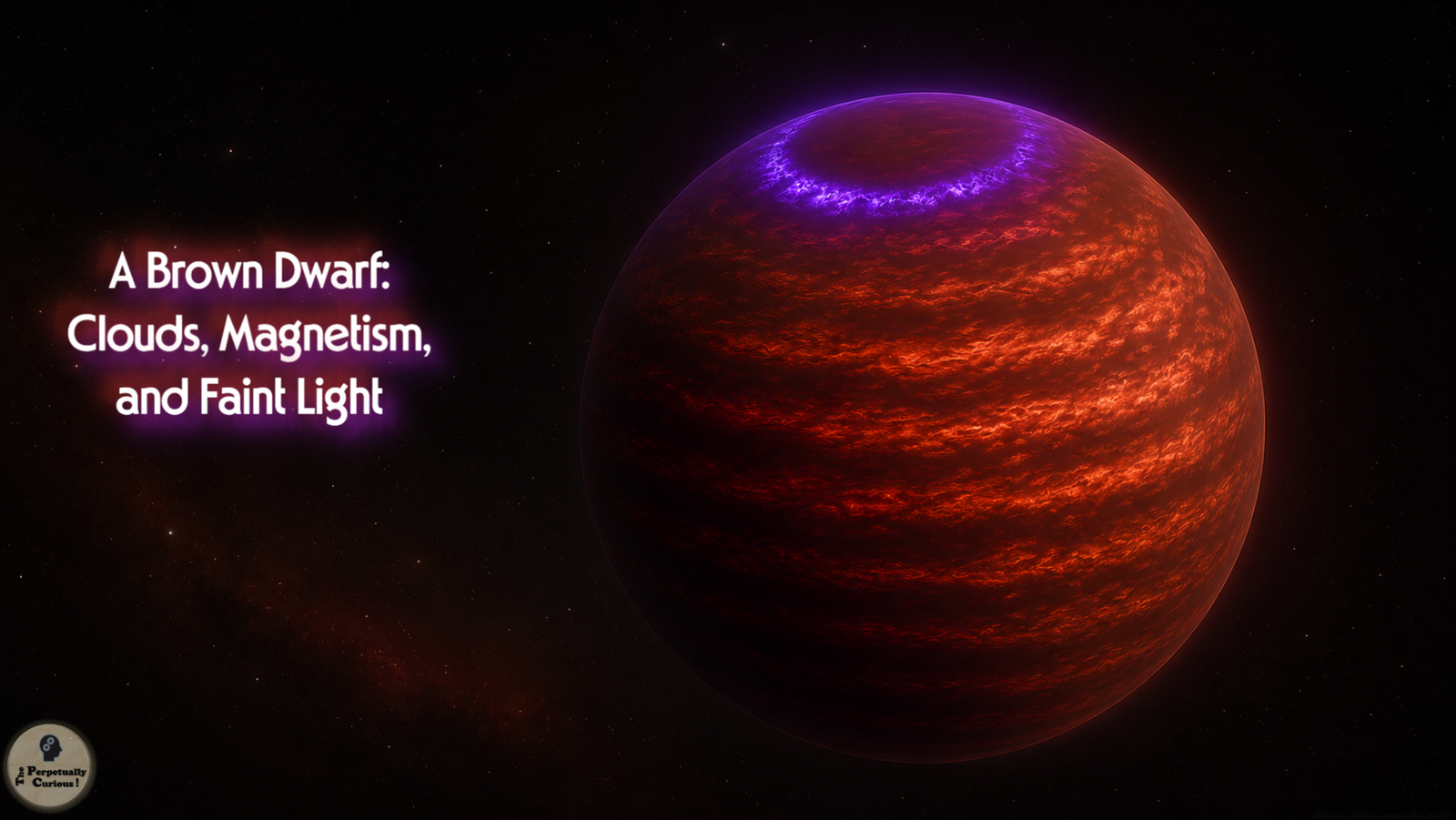
A brown dwarf begins with a question that gravity cannot answer by itself. As gas contracts, the interior grows denser and hotter. Yet heating alone does not make a star. The object must sustain ordinary hydrogen fusion rapidly enough to replace the energy escaping from its surface and establish a stable balance between inward gravity and outward pressure.
Brown dwarfs approach that threshold without crossing it. They occupy the substellar region between giant planets and the smallest hydrogen-burning stars. Astronomers often use about 13 times Jupiter’s mass as a practical lower boundary because deuterium burning can become possible near that scale, although models place the threshold from roughly 11 to 16 Jupiter masses. At the upper edge, sustained hydrogen burning becomes possible near 0.075 solar masses, or about 78.5 Jupiter masses, for material with a composition similar to the Sun.
🔥 When contraction almost makes a star
A young brown dwarf can form through fragmentation and gravitational collapse broadly similar to the formation of a low-mass star. As material falls inward, gravitational energy becomes heat, raising the central density and temperature. Some brown dwarfs grow hot enough to fuse deuterium, and the most massive can gradually destroy lithium through nuclear reactions. These brief episodes matter, but they do not create the long-lived energy source that defines a true star.
The conditions required for sustained hydrogen fusion involve more than reaching a hot core. Nuclear reactions must release energy consistently enough to offset what the object radiates into space. In a star, that feedback produces a stable main-sequence state. In a brown dwarf, limited hydrogen reactions never supply enough energy to maintain that equilibrium.
⚛️ The quantum limit inside a brown dwarf
Continued contraction crowds electrons into an increasingly dense interior. The Pauli exclusion principle prevents electrons from occupying identical quantum states, creating resistance to further compression known as electron degeneracy pressure. Unlike ordinary thermal pressure, this quantum contribution depends mainly on density and becomes less sensitive to temperature as degeneracy strengthens.
Degeneracy does not switch on suddenly, and it is not the only support inside a young brown dwarf. Thermal pressure still contributes while formation heat remains abundant. Over time, however, partial electron degeneracy becomes increasingly important. Further contraction grows less effective at raising the central temperature, so the interior reaches a maximum temperature and then begins to cool before ordinary hydrogen fusion can stabilize.
This interior physics helps explain why brown dwarfs remain close to Jupiter in size even while containing many times its mass. Across much of the brown-dwarf range, additional mass produces stronger compression rather than a proportionally larger radius. Among objects of similar age and composition, a more massive brown dwarf can even be slightly smaller than a less massive one.
🌌 A life powered by stored heat
Once any early deuterium burning and lithium depletion have run their course, no enduring nuclear source replaces the energy escaping into space. A brown dwarf continues shining mainly by releasing internal energy retained from formation and contraction. Much of that faint emission emerges in the infrared, and the object becomes progressively cooler and dimmer with age.
It never settles onto the main sequence, expands into a red giant, or ends in a supernova. Its defining story is quieter: gravity brings it close to starhood, quantum mechanics limits further heating, and cooling becomes its long-term evolution. The wider brown-dwarf story on our main site follows this threshold into infrared discovery, changing L, T, and Y atmospheres, weather, companions, the Galactic population, and the distant cooling future.
A brown dwarf is therefore not a star that burned out. It is an object whose interior never established sustained hydrogen fusion in the first place. That distinction turns a narrow difference in mass into an entirely different cosmic biography, revealing how gravity, heat, pressure, and quantum physics divide the smallest stars from the dark worlds beside them.
Comments
Post a Comment