
🌟 How Stars Form: Why Collapsing Gas Must Shed Its Spin
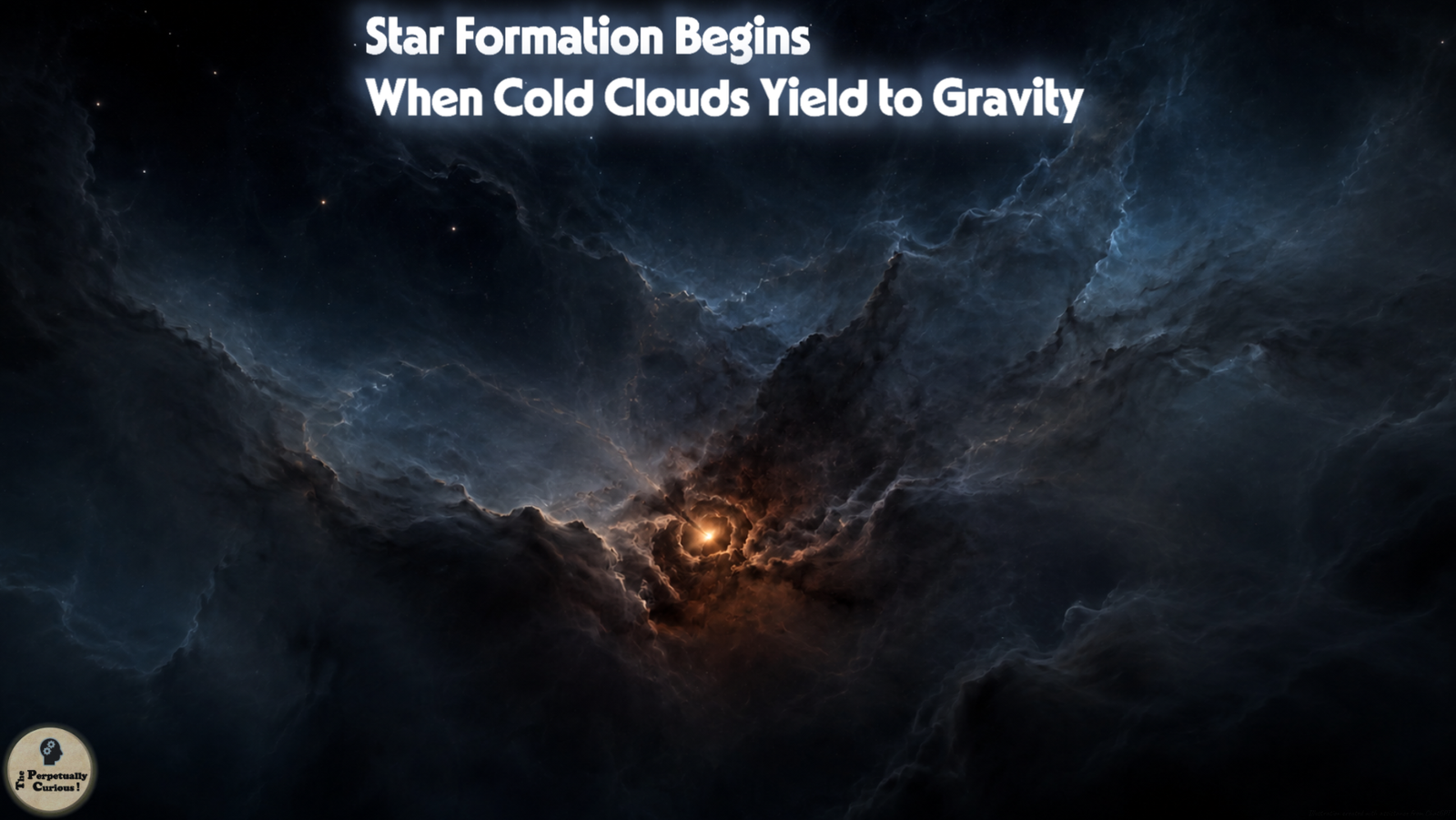
At first glance, star formation can sound like a simple victory for gravity. A cold cloud becomes dense enough, material falls inward, pressure and temperature rise, and a star eventually appears. Yet collapsing gas carries motion with it. Even a slight initial rotation becomes increasingly important as the cloud contracts, turning spin into one of the central obstacles that a forming star must negotiate.
The reason is conservation of angular momentum. When rotating material moves closer to its axis, it tends to spin faster, much like a figure skater drawing in extended arms. A shrinking cloud core therefore does not simply fall straight toward one point. As rotation speeds up, some of the infalling material is redirected into orbit around the growing protostar.
💫 When collapse meets a rotational barrier
That change in motion produces a flattened circumstellar disk. Gravity is still pulling inward, but orbital motion now matters strongly in the plane of the disk. Material with too much angular momentum cannot immediately join the central protostar. Instead, it can remain in orbit unless some of that angular momentum is moved elsewhere.
This is sometimes described as an angular-momentum barrier. It does not mean that the entire molecular cloud suddenly stops collapsing. Rather, it means that continued accretion onto the central object requires a pathway for angular momentum to be redistributed or carried away. Without that pathway, rotation would increasingly limit how efficiently the protostar could assemble its mass.
The wider path from an unstable molecular cloud to sustained hydrogen fusion includes additional thresholds involving temperature, density, mass, magnetic fields, and nuclear physics. That broader sequence is developed in the main-site treatment of how stars form, while the rotational problem reveals why collapse itself is not a simple inward fall.
🌀 How the disk keeps material moving
A circumstellar disk is therefore more than leftover material surrounding a young star. It is part of the machinery that makes continued growth possible. Interactions within the disk can transfer angular momentum outward while allowing some gas to spiral inward. Magnetic fields can also couple to charged material and help redistribute rotational motion.
Young stellar systems often produce disk winds and bipolar outflows along the rotation axis. These outflows are not launched by angular momentum alone. They arise from magnetized accretion processes, but they can carry angular momentum away from the star-disk system. The result is a continuing exchange: some material reaches the protostar, some moves outward through the disk, and some is expelled into the surrounding cloud.
This same rotating architecture also links stellar birth to planetary beginnings. Material that remains in the disk can later participate in the assembly of planets, moons, asteroids, and other small bodies. That continuity is especially clear in how the young Sun and Earth formed, where a rotating protoplanetary disk becomes the setting for the next stage of cosmic construction.
🌟 Why losing spin matters to stellar birth
Seen this way, stellar birth is not simply a matter of gathering enough gas. Gravity must draw material inward while the system continually manages the motion that the gas already possesses. Rotation creates structure, the disk provides a route for redistribution, and magnetic fields and outflows help remove part of the angular momentum that would otherwise resist further accretion.
Only after enough material can continue reaching the center does the protostar move toward the temperatures and densities required for sustained hydrogen fusion. The disk may remain long after that transition begins, carrying the record of how the star assembled and providing the raw material from which a planetary system may emerge.
A newborn star is therefore the outcome of a controlled loss as much as a collapse. Matter falls inward, but angular momentum must find routes outward. In that exchange, a diffuse rotating cloud can gradually become a star, a disk, and perhaps, in time, a family of worlds.
Comments
Post a Comment