


🧬 When Proteins Forget Their Shape: The Molecular Tragedy of Neurological Disease
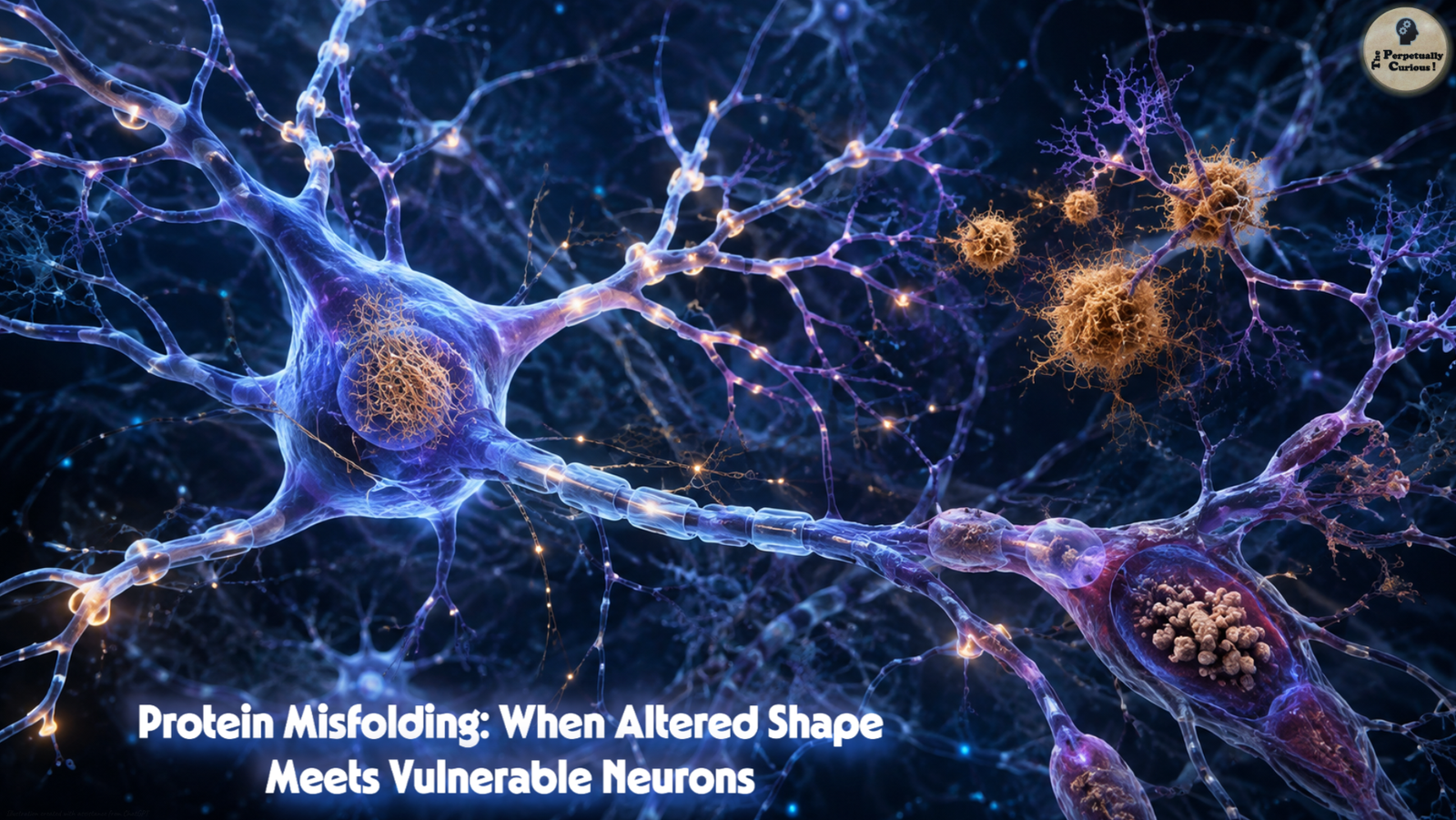
A misfolded protein can appear in more than one part of the nervous system, yet neurodegenerative disease rarely damages every neuron equally. That unevenness is one of the central puzzles of disorders such as Parkinson's disease and amyotrophic lateral sclerosis. The protein matters, but so does the kind of cell that has to live with it.
This is why a map of plaques, tangles, or other aggregates cannot by itself explain the pattern of a disease. Molecular pathology may be widespread while symptoms still reflect the failure of particular circuits. To understand why movement, memory, speech, or other functions are affected in characteristic ways, researchers have to look beyond the abnormal protein and ask what makes one neuronal population more vulnerable than another.
🧬 The protein is only half the problem
Proteins normally fold into three-dimensional forms that let them work as enzymes, receptors, scaffolds, transport machinery, and signaling components. Cells also maintain quality-control systems that refold damaged proteins or remove those that cannot be repaired. When harmful protein forms persist, they can disturb membranes, transport, metabolism, signaling, and other cellular processes. Even then, the consequences are not distributed evenly across the nervous system.
Neurons are not interchangeable. Different classes have different axon lengths, branching patterns, firing rates, neurotransmitters, calcium handling, energy demands, and relationships with surrounding glial cells. That neuronal diversity helps explain why the same broad category of molecular stress can be manageable in one cell and overwhelming in another.
🧩 Different neurons, different burdens
Consider the scale problem faced by motor neurons. Some extend axons close to 3 feet (1 meter) from the spinal cord to distant muscles. Every protein, organelle, nutrient, and signal required at the far end of that axon must be transported across an extraordinary cellular distance. A disruption in protein quality control or axonal transport therefore lands on a system that already carries a demanding logistical burden.
Dopamine-producing neurons of the substantia nigra face a different challenge. Their chemistry can generate reactive byproducts, their autonomous electrical activity requires sustained energy, and many maintain enormous branched axonal arbors. Calcium entry through L-type channels adds to that metabolic workload. None of these features alone explains Parkinson's disease, but together they help show why certain neurons may have less room to absorb additional cellular stress.
🌱 Resilience changes the question
Selective vulnerability becomes especially revealing when researchers compare cells that degenerate with cells that remain relatively resistant. In ALS, for example, oculomotor neurons controlling eye movements often withstand disease better than many spinal motor neurons. Their relative resilience suggests that vulnerability is not simply the unavoidable result of carrying a disease-associated protein. Protective programs involving calcium handling, metabolism, transport, stress responses, or protein clearance may also matter.
This changes the therapeutic question. Removing or reducing a harmful protein can be important, but researchers are also asking whether the cell itself can be made more resilient. Could vulnerable neurons improve their ability to manage oxidative stress, maintain long-distance transport, or clear damaged proteins? Could protective features found in resistant neuron populations point toward new forms of neuroprotection?
The broader treatment on our main site follows the wider relationship between protein shape and neuronal vulnerability through Alzheimer's disease, Parkinson's disease, ALS, biomarkers, and emerging therapies. Here, the narrower lesson is enough to shift the picture: neurodegeneration is not only a story about what a protein becomes. It is also a story about the cell in which that protein has to survive.
A protein may be only nanometers across, while a neuron can extend through much of the body. Disease emerges where those scales meet. The smallest molecular change can become consequential not because every neuron is equally fragile, but because every neuron carries a different architecture, workload, and margin for recovery.
Comments
Post a Comment