

The Neural Symphony: How Your Brain's Diverse Neurons Orchestrate Human Experience 🧠
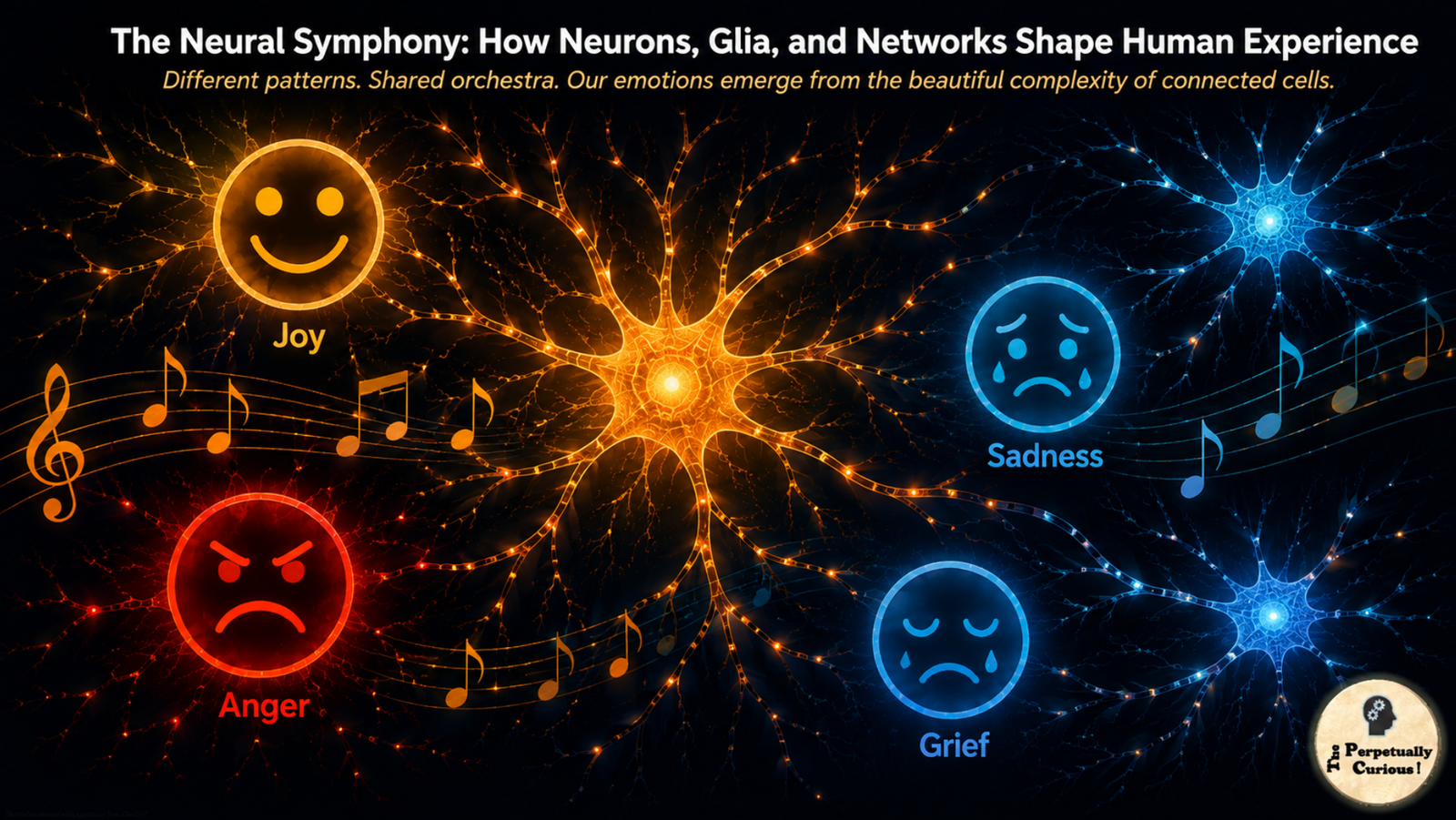
Have you ever wondered why a memory can bring joy, a moment can trigger fear, or a loss can create a wave of sadness? These experiences feel immediate and personal, yet they begin with countless signals moving through the living networks inside the brain.
For many years, popular explanations suggested that emotions came from simple causes: one chemical for happiness, one region for fear, or one pathway for love. Modern neuroscience reveals a more intricate picture. Feelings emerge from coordinated patterns involving neurons, glial cells, chemistry, memory, and context.
🧩 Beyond single chemicals and simple explanations
Neurotransmitters such as dopamine, serotonin, glutamate, and GABA all influence brain activity, but none creates an emotion alone. Their effects depend on where they act, which receptors respond, and how surrounding networks are organized.
The brain also depends on glial partners. Astrocytes help regulate the chemical environment around neurons. Microglia help maintain and reshape neural connections. Oligodendrocytes support communication by insulating axons. Together, these cells create the conditions in which emotional experiences can emerge.
🌐 Emotions as living network patterns
A feeling is not produced by a single location in the brain. Instead, many regions contribute different pieces of the experience. Sensory systems detect events, memory systems provide context, emotional circuits evaluate significance, and regulatory regions help shape responses.
This coordinated activity also explains why the same event can produce different emotions in different moments. A familiar song may bring comfort one day and sadness another. The networks involved are shaped by memory, attention, body state, and experience.
For the complete exploration of how neurons, glia, brain regions, and emotional systems work together, continue into the full article: how the brain creates emotions.
🌙 A brain that changes with time
Emotion is not fixed. Sleep, learning, daily rhythms, and life experiences continuously reshape the networks involved in feeling and thought. The brain is not simply an organ that produces emotions. It is a living system that constantly adapts.
The deeper lesson is that human emotion is not the work of one cell, one chemical, or one moment. It is a symphony created through cooperation across billions of living components.
Comments
Post a Comment