🌈 Rainbow Formation: Why Every Observer Sees a Different Arc
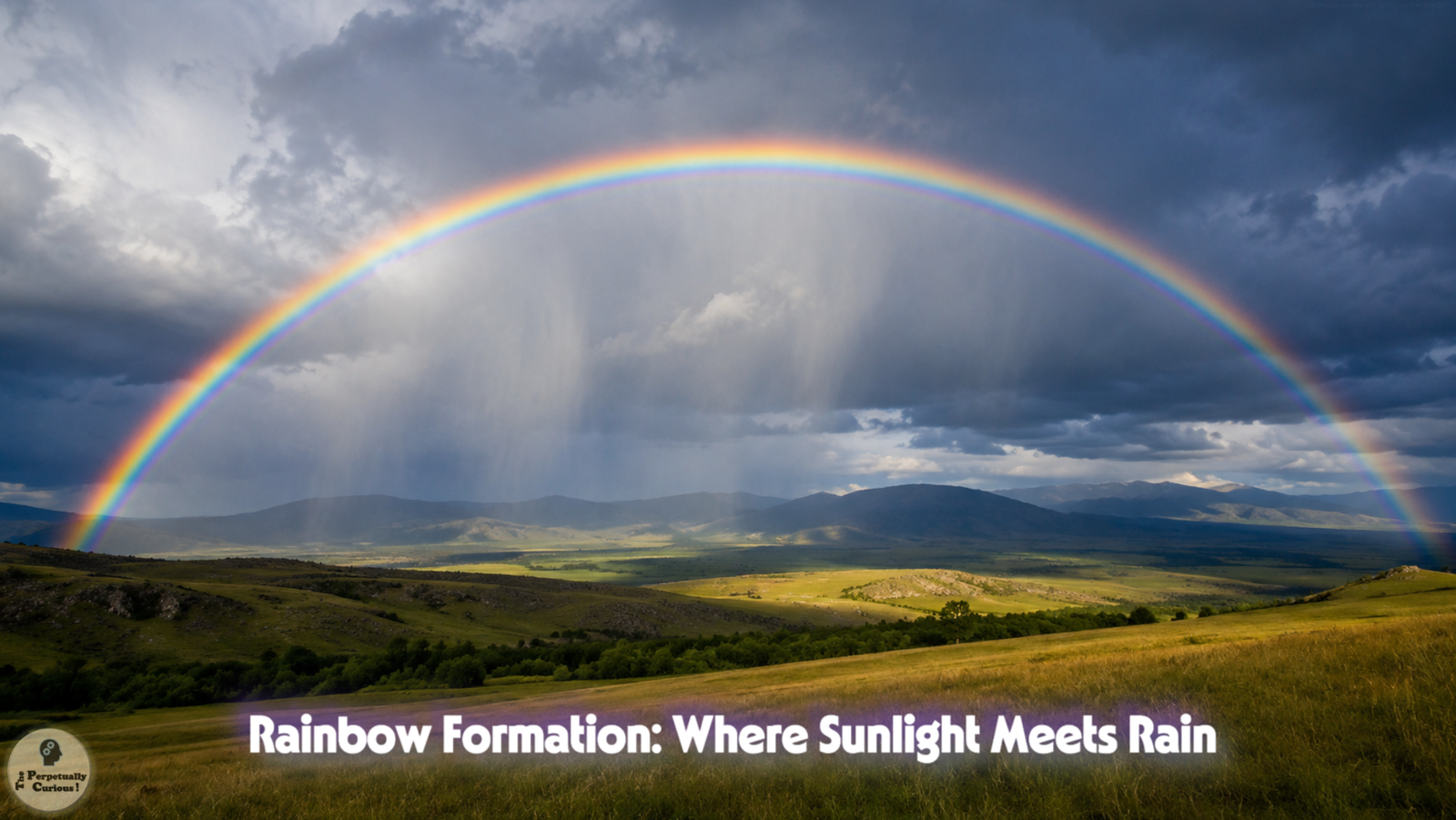
A rainbow can look like a colored bridge resting on a distant valley, field, or line of trees. Yet the arc is not anchored to that landscape. It is assembled for a particular observer by a particular set of illuminated water droplets. Move a few steps, and a new group of droplets begins sending the required light toward the eye.
This is why a rainbow can appear steady while the water producing it is continually changing. The pattern remains recognizable because the geometry is stable, even though the individual droplets are not.
A rainbow begins with a viewpoint
The essential arrangement places the Sun behind the observer and illuminated droplets ahead. Directly opposite the Sun lies an imaginary direction called the antisolar point. The visible bow forms around that point, not around a cloud, mountain, or other feature in the landscape.
Inside each suitable droplet, sunlight changes direction as it enters the water, partly reflects from the rear boundary, and changes direction again as it leaves. Different wavelengths are bent by slightly different amounts, spreading the returning light into color. Most of those rays travel elsewhere. Only droplets positioned along particular sightlines return the concentrated colored light that reaches one observer.
The droplets may belong to a passing shower, mist, fountain spray, or waterfall plume. Their atmospheric origin is a separate process, traced through how raindrops grow inside clouds. Once liquid droplets are illuminated, however, their position relative to the Sun and the observer determines whether they contribute to the visible arc.
The 42-degree cone behind the arc
For the primary rainbow, red light reaches the observer from directions roughly 42 degrees away from the antisolar point. Violet appears slightly closer to the center, near 40 degrees, because water bends shorter wavelengths more strongly. The familiar bands occupy the narrow angular spread between them.
The important measurement is an angle, not a fixed distance. A nearby droplet and a faraway droplet can both contribute if each lies along the correct line of sight. Imagine the observer at the tip of a cone whose axis points directly away from the Sun. Droplets distributed around the surface of that cone can return rainbow light to the eye. Seen against the sky, that circular cone becomes the rainbow’s circle.
From the ground, the horizon usually hides the lower part, leaving an arc. From an aircraft or another elevated viewpoint, droplets may lie below the observer, allowing much more of the circle to appear. The broader optics, including secondary bows, delicate interference fringes, and other variations, remain part of the main-site treatment of rainbow formation.
Why the bow changes when you move
Two people standing close together may see rainbows that look almost identical, but they do not receive light from exactly the same droplets. Each observer occupies the tip of a slightly different cone. The required sightlines therefore pass through a different part of the rain or mist.
The same principle explains why the apparent end of a rainbow cannot be reached. As the observer moves, the antisolar point and the cone move as well. Droplets that once contributed fall away from the necessary angle, while others take their place. The bow is rebuilt continuously rather than left behind as a stationary object.
Its visibility can also change as clouds shift, droplets fall, sunlight brightens or weakens, and the observer changes position. Portions of the arc may intensify, fade, or disappear, yet the underlying rule remains the same: only light returned along the correct observer-centered geometry becomes part of that rainbow.
A rainbow is therefore personal without being imaginary. The laws shaping it are universal, but each visible arc is completed along one particular line of sight. What appears to rest across the landscape is really a momentary meeting of sunlight, water, angle, and observer.
Comments
Post a Comment