


🖋️ Printing Ink: What Happens When a Wet Drop Meets Paper
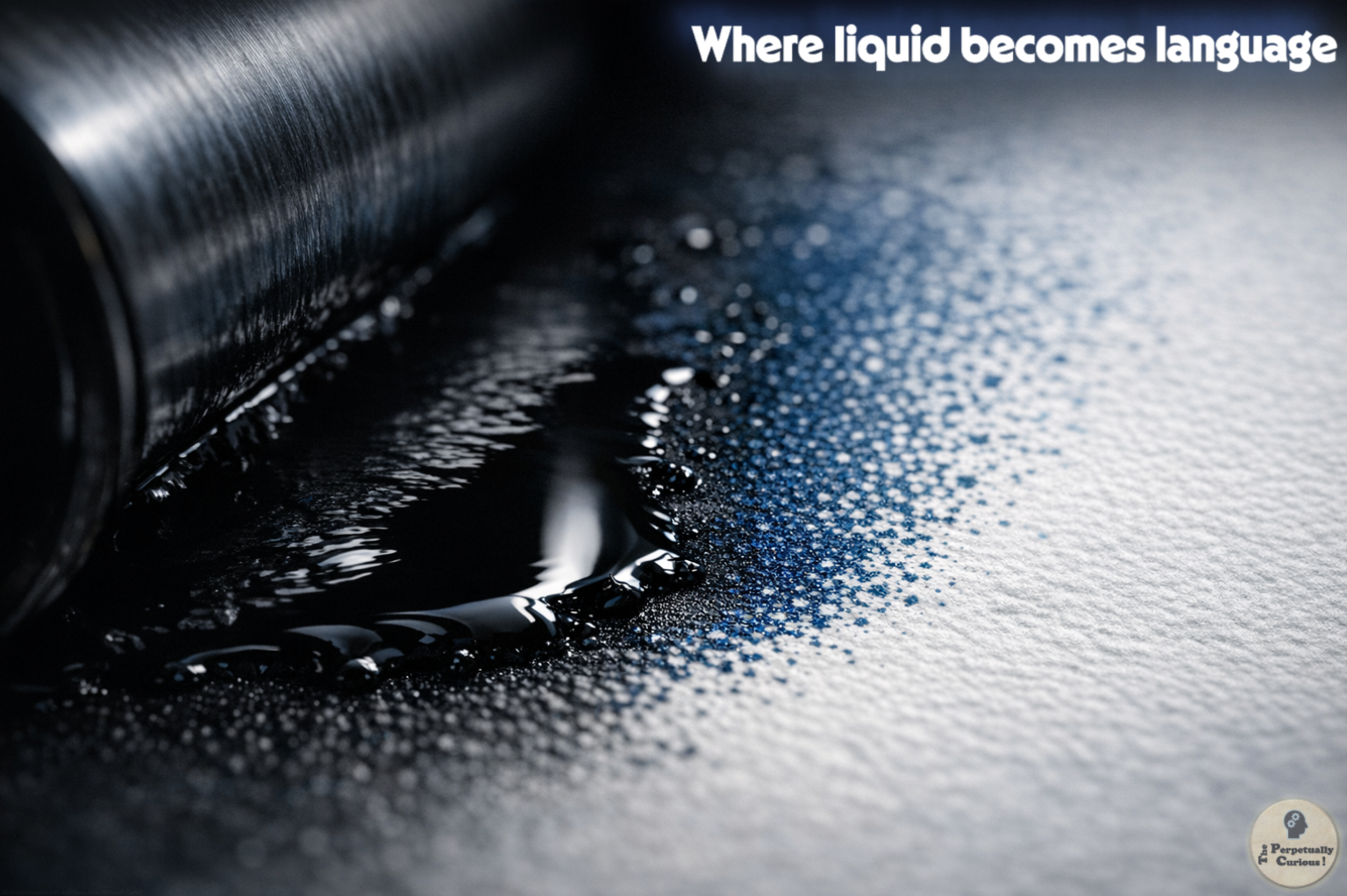
Freshly printed letters look complete almost as soon as they appear. At the microscopic scale, however, the mark is still becoming itself. A thin liquid film has just struck a surface made of fibers, pores, coatings, and air spaces. For a brief interval, flow and surface chemistry help determine whether the result will be crisp, dull, glossy, blurred, or easy to rub away.
This moment is more than simple drying. Printing ink must arrive with enough mobility to transfer cleanly, spread only as far as intended, and then lose that mobility in a controlled way. The page is not a passive background. It participates in the final mark.
🖨️ Before the ink touches the page
Before contact, ink is a coordinated mixture rather than color alone. A pigment or dye provides the visible hue. A liquid vehicle carries it through a roller, plate, or nozzle. A binder helps secure the colorant after application, while small amounts of additives can tune wetting, flow, and resistance to rubbing.
Two properties are especially important during transfer. Viscosity describes how strongly the ink resists flowing, while surface tension helps govern the shape of its exposed surface and the way it begins to spread. If the balance is poorly matched to the printing method or substrate, ink may travel beyond the intended edges, fail to transfer evenly, or settle into an irregular film. The formulation must remain mobile long enough to move, but controlled enough to stop in the right place.
🔬 The brief life of a wet film
When ink reaches uncoated paper, part of its liquid phase begins entering tiny spaces within the sheet. This is not the whole ink vanishing into the page. The carrier can move into pores while much of the colorant and binder remains nearer the surface, where the visible mark takes shape. How quickly this happens depends on the ink, the paper, and the contact conditions.
That interaction depends on the microscopic network of paper fibers, which provides capillary spaces for the liquid phase while influencing how far the colorant can travel. A more absorbent sheet may accept liquid quickly but allow a mark to spread and lose sharpness. A smoother coated sheet can hold more of the ink near the surface, often supporting stronger color and finer detail.
The printed edge is therefore a record of a short negotiation. The ink tries to flow outward, the surface resists or welcomes it, and the paper structure redirects part of the liquid inward. Press speed, film thickness, temperature, and formulation all influence the outcome, but the central encounter lasts only a moment.
📄 What remains after the motion stops
As the carrier leaves the wet film by absorption or evaporation, the colorant becomes less mobile and the binder helps anchor it. The surface may feel dry even while slower setting processes continue within the film. What began as a flowing mixture becomes a thin material layer with its own gloss, texture, strength, and response to light.
Paper is only one destination, and absorption is only one route by which ink can set. The broader science and living history of printing ink follows how pigments, binders, printing systems, curing methods, lifespans, and changing human uses extend far beyond this single meeting between liquid and page.
A printed word may look still, but its stillness is the result of carefully controlled motion. Every sharp letter preserves the outcome of that brief passage from mixture to film, from flow to attachment, and from a wet trace to a mark the page can keep.
Comments
Post a Comment