🌊 How El Niño Affects Weather: When the Pacific Shifts the Odds
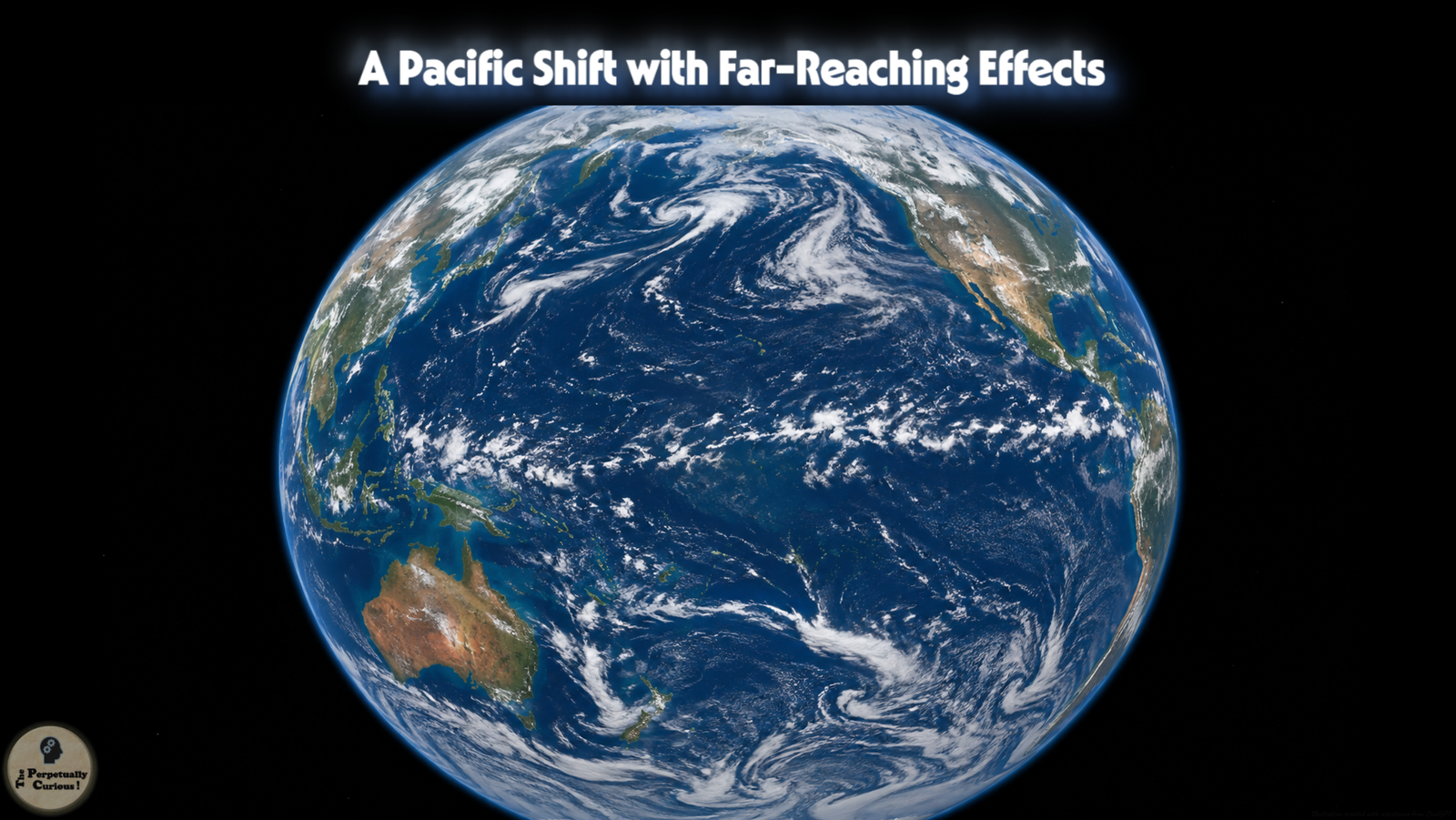
The tropical Pacific can change the character of a season far from its own shores, but not by sending one continuous weather system around the world. El Niño works more subtly. It reorganizes the relationship between warm ocean water, winds, rising air, and tropical rainfall, then the atmosphere carries that rearrangement outward.
That distinction matters because El Niño is often described too simply as a cause of floods, droughts, or unusual winter weather. In reality, it changes probabilities. It can make some seasonal patterns more likely while leaving room for local weather systems, regional geography, and other climate influences to shape what actually happens.
When warm water and rainfall shift east
Under typical tropical Pacific conditions, easterly trade winds help push warm surface water toward Indonesia and northern Australia. Cooler water remains closer to the surface in the eastern Pacific, where upwelling can bring it upward near South America. The contrast in ocean temperature is linked to a broad atmospheric circulation, with rising air and heavy tropical rainfall concentrated farther west.
During El Niño, the trade winds weaken and unusually warm surface water spreads across more of the central and eastern equatorial Pacific. The thermocline deepens in the east, reducing the cooling influence of upwelling, and tropical convection can shift eastward with the warmest water. Ocean and atmosphere are therefore changing together rather than acting as separate systems.
The important atmospheric consequence is not simply that the ocean becomes warmer in a new place. Tropical rainfall releases heat when water vapor condenses inside deep clouds. When the major region of tropical convection moves, an important source of atmospheric heating moves with it. That shift can disturb circulation far beyond the tropical Pacific.
In other words, the basin is not sending Pacific weather intact to distant continents. It is changing the large-scale atmospheric pattern in which regional weather develops. That difference helps explain why El Niño weather patterns are usually expressed as seasonal tendencies rather than as a direct chain from one patch of warm water to one storm, drought, or rainfall event.
The larger main-site treatment follows this coupled ocean-atmosphere development into feedbacks, monitoring, regional monsoons, cyclone tendencies, and the ways changing rainfall reaches landscapes and water systems.
Why distant seasons respond without becoming predictable
Changes in tropical heating can generate large-scale atmospheric wave responses that extend toward the subtropics and midlatitudes. These teleconnections can alter the position or strength of jet streams, pressure patterns, and storm tracks. The result is a change in the seasonal odds of rain, dryness, warmth, or storm activity across regions that may be thousands of miles from the equatorial Pacific.
This is why one El Niño can favor wetter conditions in parts of coastal western South America while increasing the likelihood of dryness across parts of Australia or Southeast Asia. Even those familiar tendencies are not guarantees. Their expression depends on the strength and location of Pacific warming, the season, and interactions with other oceanic and atmospheric patterns.
El Niño therefore does not make raindrops directly. Rain still depends on local moisture, rising air, cooling, condensation, and cloud microphysics, processes that become clearer when following how clouds and rain form. A climate signal can tilt the background conditions without dictating the weather of a particular afternoon.
That is the useful scale at which to understand El Niño. It is neither a remote ocean curiosity nor a master switch for global weather. It is a coupled Pacific reorganization that changes how the atmosphere distributes opportunity for certain seasonal patterns. The farther the signal travels, the more it mixes with local conditions and other climate influences. The Pacific may set part of the rhythm, but every region still plays its own weather within it.
Comments
Post a Comment