


🍊 Citrus Family Tree: How Ancient Lineages Became Familiar Fruits
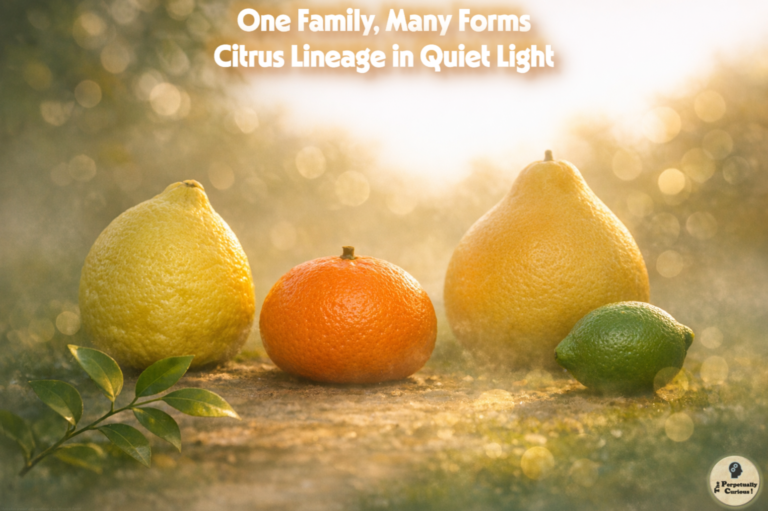
A fruit bowl can make oranges, lemons, limes, mandarins, and grapefruit look like separate botanical inventions. Their colors, flavors, and shapes seem distinct enough to suggest separate origins. The citrus family is more intertwined than that. Much of the diversity people recognize today grew from a small ancestral core, followed by repeated hybridization and human selection.
Three lineages are especially important for understanding the familiar citrus story: citron, pomelo, and mandarin. Papeda lineages also matter in the ancestry of some limes, but the central pattern is already visible in those three ancestral pillars. Modern citrus is less like a tree with perfectly separate branches and more like a family whose branches have crossed, rejoined, and crossed again.
Three ancestors behind the fruit bowl
Citron, Citrus medica, carries a thick rind, strong fragrance, and relatively little pulp. Pomelo, Citrus maxima, contributes a very different physical presence, with large fruit, substantial pith, and traits that appear again in later hybrids. Mandarin, Citrus reticulata, is associated with smaller fruit, sweetness, aroma, and the loose peel that makes many mandarin types easy to open by hand.
These ancestors did not simply produce one isolated descendant each. Over long periods, natural crossings and cultivation brought their genetic material together in new combinations. People then selected fruits for qualities they valued, such as sweetness, size, fragrance, acidity, peelability, and suitability for local growing conditions.
The familiar sweet orange shows how misleading a simple fruit name can be. It is not an untouched ancestral species. Its lineage reflects mandarin and pomelo ancestry shaped by historical hybridization and backcrossing. Grapefruit adds another turn to the pattern, arising from sweet orange and pomelo ancestry. A fruit that seems visually distinct can therefore carry lineages already mixed in an earlier fruit.
This is why the citrus family tree is better understood as a history of inheritance than as a row of unrelated species. Traits move through generations in combinations. A loose peel, a larger body, a fragrant rind, or a particular balance of sweetness and acidity can echo ancestral contributions without belonging exclusively to one branch.
Why familiar names can hide mixed ancestry
Everyday names usually describe the fruit people encounter, not the full route by which that fruit came into being. “Mandarin” can refer to an ancestral lineage and to familiar cultivated fruits. “Orange” may describe fruits that look similar while their ancestry differs. Regional names can carry culinary and cultural meaning that does not map neatly onto a genetic diagram.
That difference between appearance and ancestry is one of the most useful ways to read citrus. Two fruits can look similar without being close equivalents, while fruits with obvious differences can still share substantial ancestral material. The family resemblance is written in genetics as much as in color or shape.
The broader main-site treatment follows these relationships much farther, including the citron-influenced paths toward lemons and limes, the more complicated position of sweet lime, regional South Indian citrus names, pollination, peel color, comparison tables, and a fuller set of reader questions. The complete citrus family tree on our main site keeps those branches together without compressing them into a single ancestry sketch.
Once the ancestral pattern is visible, the supermarket display changes slightly. An orange is no longer only an orange, and a grapefruit is not simply a larger neighboring fruit. Each is part of a long botanical history in which old lineages met, separated, and recombined.
The result is not botanical disorder. It is inheritance made visible through rind, aroma, sweetness, acidity, and form. A familiar bowl of citrus is, in that sense, a small family reunion.
Comments
Post a Comment