


🌿 Why Henna Stains Fingertips More Deeply Than Other Skin
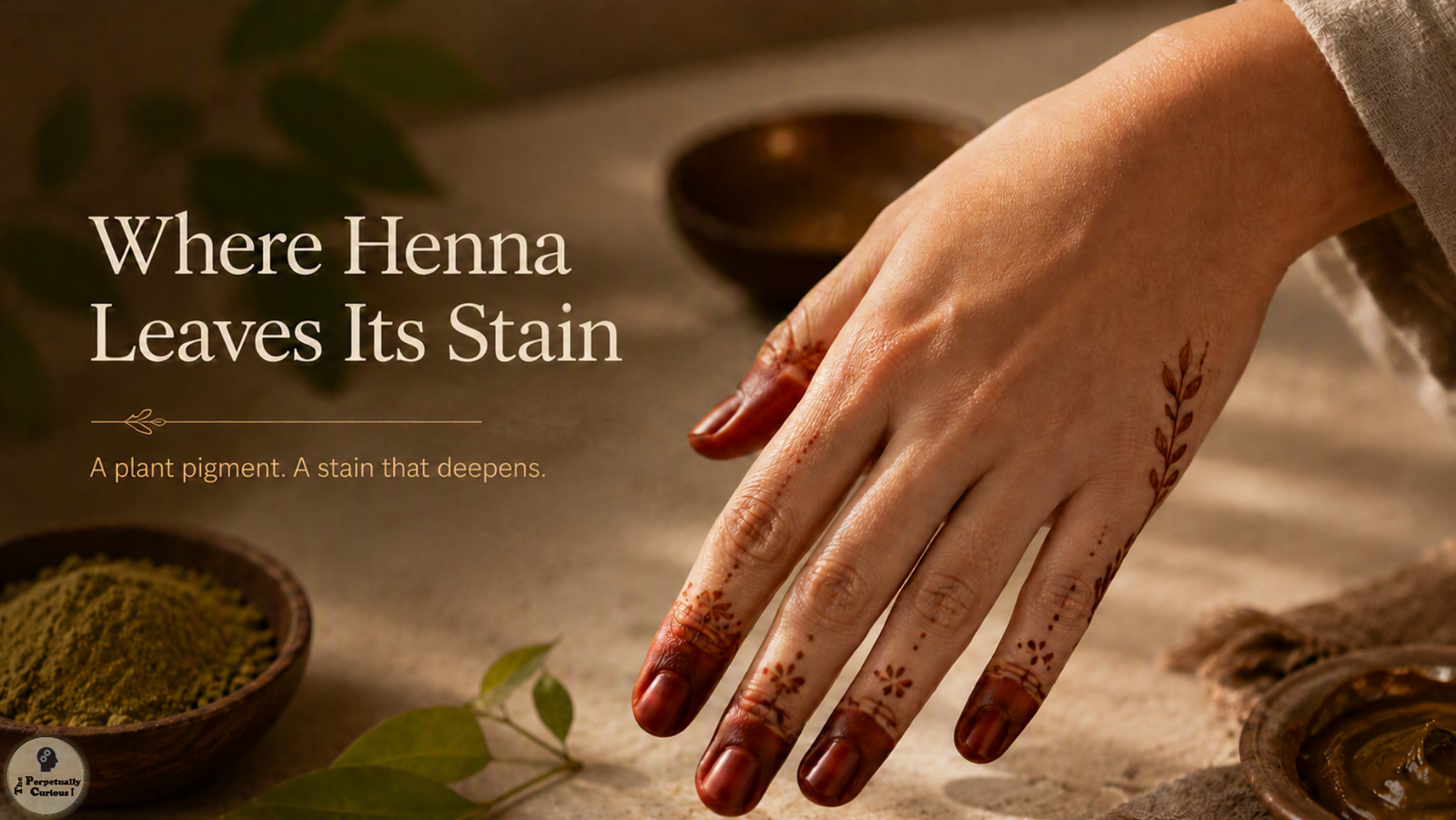
When dried henna paste is removed, the color beneath it can look almost modest: a clear orange tracing the fingertips and palm. By the following day, the same marks may have deepened toward reddish-brown. The change is especially striking on the parts of the hand that touch, grip, and press against the world most often.
That uneven depth is not accidental. Henna does not color every part of the body equally because skin itself is not built the same way everywhere. The darkest results tend to appear where the outermost layer is thick, keratin-rich, and able to hold more pigment.
The stain does not simply sit on the skin
Henna leaves contain lawsone, an orange-red pigment that becomes available when the leaves are crushed or ground and prepared as a paste. Henna therefore belongs to the wider history of natural dyes, but its behavior on the body depends on the particular material it meets.
The visible surface of the skin is covered by the stratum corneum, a layer of flattened, nonliving cells filled with keratin. Lawsone moves into this outer layer and reacts with sites on keratin proteins. The resulting color is held within the keratinized cells rather than resting loosely on top of them.
This is why ordinary rinsing does not remove a mature henna stain in the way water removes a surface coating. The pigment remains until the stained cells are gradually lost through normal skin renewal, washing, and friction. Henna is temporary, but its temporary nature follows the biology of the skin.
Why fingertips keep more of the color
The stratum corneum is much thicker on the palms, fingertips, and soles than it is on areas such as the forearm. These surfaces need extra protection because they repeatedly meet pressure, movement, and abrasion. Their greater mass of keratinized tissue also gives lawsone more material through which to diffuse and react.
A fingertip can therefore develop a darker, more persistent stain than thinner skin exposed to the same paste. Contact time, warmth, paste quality, skin preparation, and the presence of oils or lotions can influence the result, but the structure beneath the paste establishes an important starting condition.
The color also matures after the paste has gone. Freshly revealed henna is usually orange. Over the next 24 to 48 hours, continuing chemical changes, including oxidation, deepen the stain toward reddish-brown or mahogany. The main-site article follows that broader path through the plant, pigment chemistry, cultural traditions, and the meanings attached to decorated hands, while the focus here remains on why the fingertips provide such a receptive surface.
A design guided by living topography
Henna does not erase the anatomy of the hand. Fine ridges, folds, and valleys remain visible beneath the color, so the design is partly shaped by a surface that already has its own geometry. On the fingertips, the stain follows the existing micro-landscape instead of creating a separate texture.
The hand then begins to change the design through use. Frequent washing and repeated contact can lighten exposed areas more quickly, while deeper or less abraded regions may hold color longer. The fading is often uneven because skin renewal and friction are uneven.
For a brief time, plant pigment and human anatomy occupy the same surface. Lawsone supplies the color, keratin holds it, and the thick outer skin of the fingertips gives the stain unusual depth. The pattern may be drawn by an artist, but its final appearance is also completed by the quiet architecture of the hand.
Comments
Post a Comment