
🌙 White Half Moon on Nails: The Quiet Growth Zone Beneath
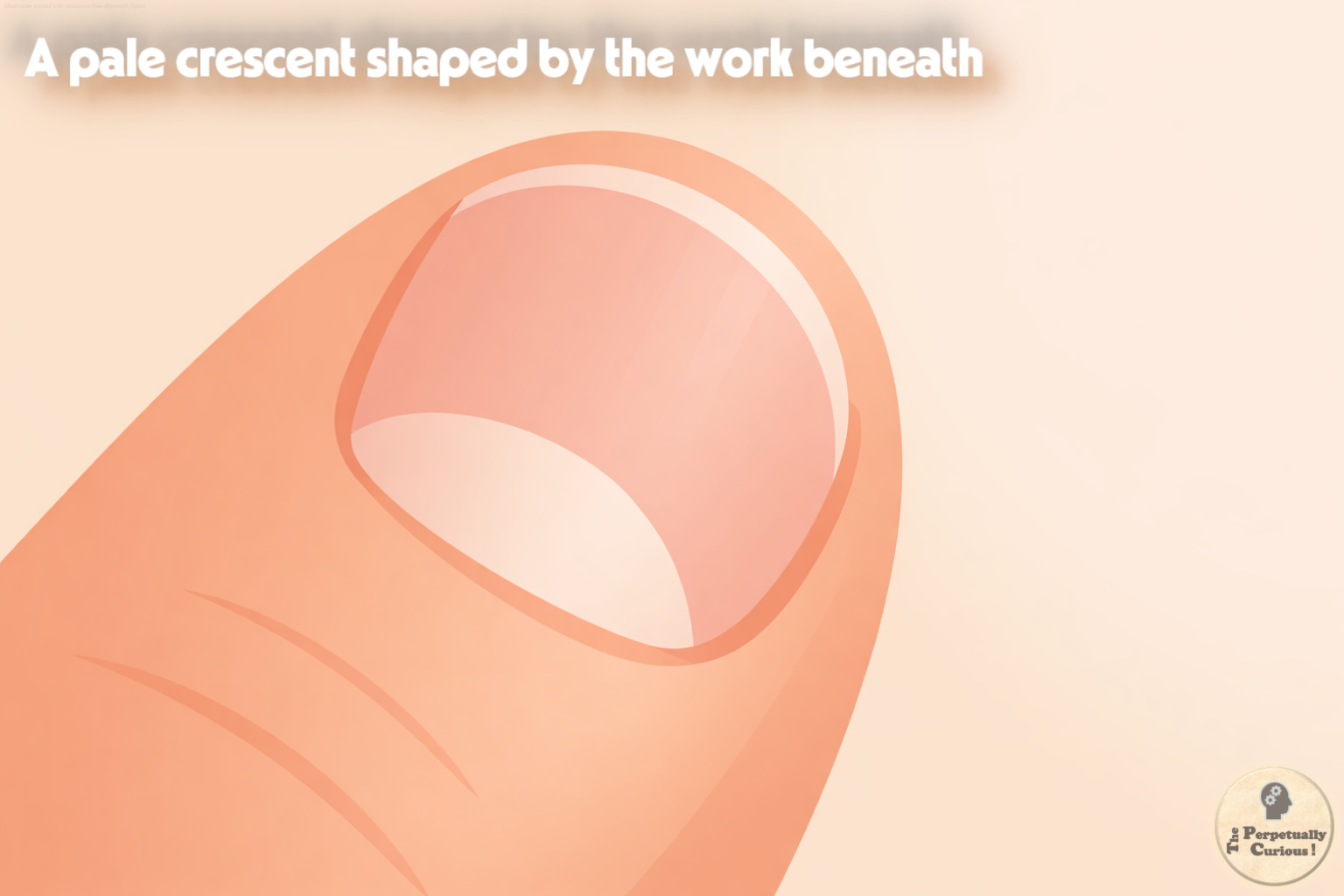
At the base of some fingernails, a pale crescent appears like a small moon partly tucked under the skin. It may be broad and clear on the thumb, faint on another finger, or almost absent from view. That uneven visibility can make the white half moon on nails feel mysterious, as if it were a private code written into the body.
The name for this crescent is the lunula. Its meaning begins not with symbolism, but with nail anatomy. The lunula is not a loose mark, stain, or separate object under the nail. It is the visible part of the nail matrix, the living region that produces new nail cells.
The crescent begins in the matrix
A fingernail is built from several related structures. The hard surface that we trim is the nail plate. The pink tissue beneath most of it is the nail bed. At the base, partly hidden under the proximal nail fold, sits the nail matrix. This is the active growth zone where cells divide, fill with keratin, flatten, and gradually become part of the nail plate.
The lunula appears pale because the matrix region is thicker than the nail bed in front of it. Newly forming keratinocytes in this zone have not yet been fully compressed into the harder, clearer nail plate. They scatter light and reduce the visibility of the tiny blood vessels below. That is why the lunula looks whitish while the rest of the nail often looks more pink.
The crescent shape also comes from structure. The matrix sits under the skin as a curved growth region, and only its forward edge is usually visible. Where that visible edge meets the thinner nail bed, the familiar arc appears. From there, the anatomy opens into a wider story on our main site, including toe lunulae, health caution, cultural meanings, and visual diagrams, while the focus here stays with the small crescent itself.
Why the thumb often shows it best
The thumb usually has the most obvious lunula because the thumb nail is broader and the matrix beneath it is often more exposed. A larger growth zone can place more of the pale matrix within view. Smaller fingers may have shorter matrices, thicker surrounding folds, or nail plates that make the crescent harder to see.
This variation is common. One person may see lunulae on several fingernails, while another may notice them mainly on the thumbs. The same person may also see differences between fingers. These differences do not automatically mean that one nail is healthier than another. They often reflect ordinary anatomy, including nail thickness, matrix position, skin coverage, and growth rate.
The lunula belongs to the broader world of visible body patterns, where small features can reveal how tissues grow, fold, protect, and respond over time. That is why it fits naturally within the Biology & Health collection, alongside other quiet features of human form and physiology.
A clue, not a diagnosis
Because nails grow slowly, they can sometimes preserve traces of long-term changes in the body or local injury. A damaged matrix may leave ridges or shape changes that take months to grow out. Illness, nutrition, circulation, aging, and everyday wear may also influence nail appearance in different ways.
Even so, the lunula alone should not be asked to carry too much meaning. Large lunulae, faint lunulae, or hidden lunulae can all occur in healthy people. A pale crescent on the thumb is usually a normal anatomical feature, not a message that needs constant interpretation. Sudden, persistent, painful, or widespread nail changes are better understood in the context of the whole nail, the surrounding skin, and overall health.
Seen with that restraint, the lunula becomes more interesting rather than less. It is a small visible edge of an active growth system, shaped by cells, keratin, tissue thickness, and light. Its quiet arc reminds us that even ordinary details on the body can open into a layered story. The wider landscape includes development before birth, differences between fingers and toes, cultural meanings, health nuance, and the patient timing of nail growth, all held behind a crescent most people have seen without quite noticing.
Comments
Post a Comment