
🚂 Train Engines: How Steam, Diesel, and Electricity Reach the Wheels
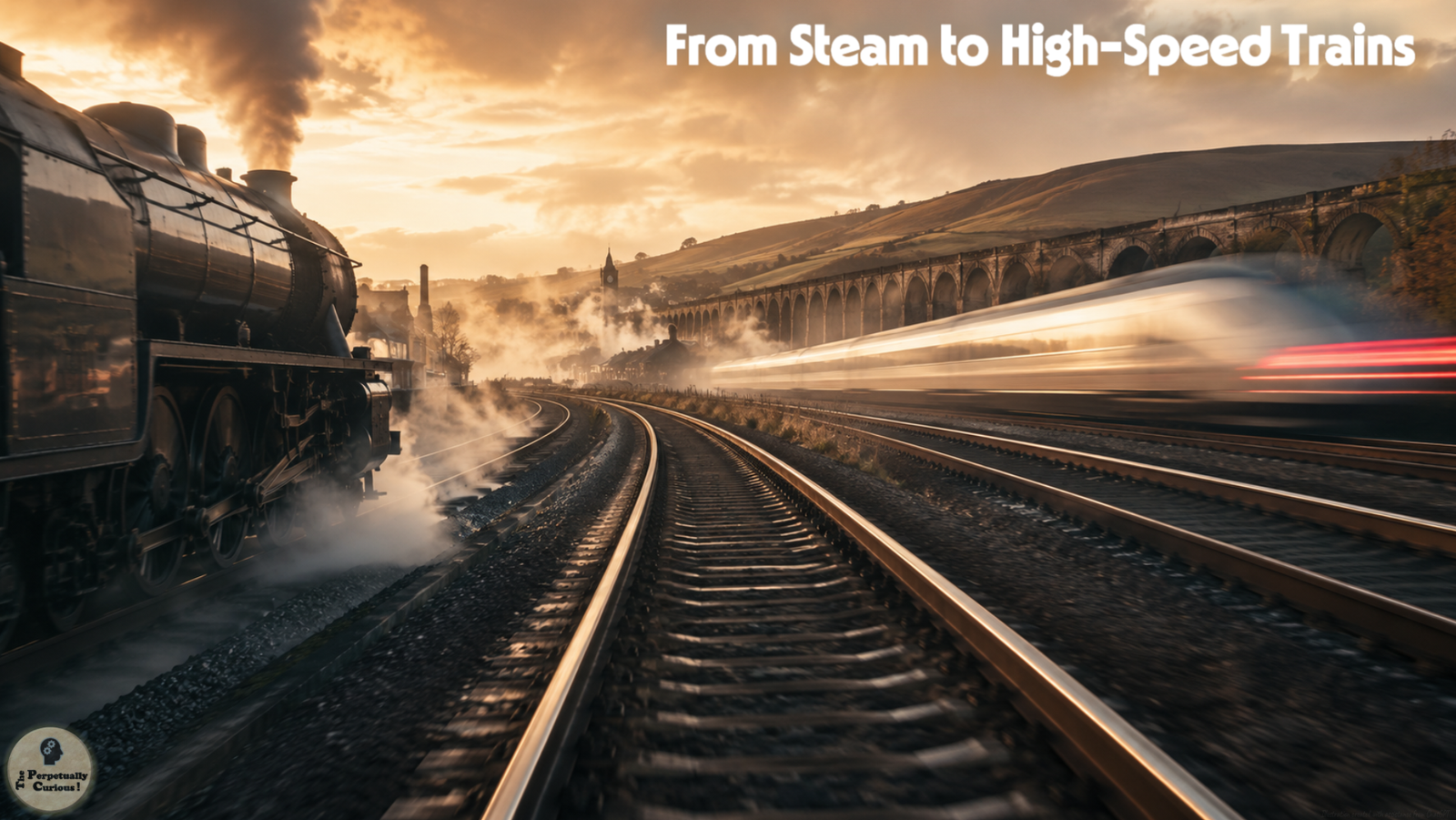
At a railway station, the source of motion can announce itself in very different ways. A steam locomotive breathes through exhaust beats and visible vapor. A diesel locomotive carries a steady mechanical pulse. An electric train may leave with little more than the sound of traction motors and wheels beginning to turn. All three move steel wheels along steel rails, yet the route from stored energy to motion is fundamentally different.
That contrast reveals the central engineering story of train engines. The wheel and track provide the guided path, but the locomotive must create controlled turning force, or traction, without wasting so much energy or demanding so much support that the railway becomes impractical. Over time, engineers changed where energy was stored, how it was converted, and how precisely it reached the axles.
🔥 Fire, water, and the first self-moving railway machine
A steam locomotive carries its energy process almost entirely on board. Fuel burns in a firebox and heats water inside a boiler. The expanding steam enters cylinders, where pressure pushes pistons back and forth. Connecting rods translate that reciprocating motion into rotation at the driving wheels.
This arrangement made mechanical power mobile. A machine no longer had to remain beside a mine pump or factory shaft. It could carry its boiler, fuel, water, and working mechanism along the track while pulling a load behind it. In many regions, coal supplied the concentrated heat, linking railway expansion to coal's formation from ancient plant matter across deep time.
The visible drama of steam also concealed a demanding operating system. Water had to be replenished, fuel handled, fires managed, ash and soot removed, and moving parts inspected and lubricated. Steam locomotives could be strong and durable, but much of the fuel's energy escaped as waste heat. Their power came with a large daily burden.
⚙️ Diesel changes the chain without abandoning electricity
A mainline diesel locomotive is often called diesel-electric because its diesel engine usually does not turn the wheels through a direct mechanical connection. The engine turns a generator or alternator. That machine produces electricity, and the electricity powers traction motors near the axles.
This creates a useful division of labor. Diesel fuel provides portable onboard energy, while electric motors deliver smooth, controllable torque to the wheels. The locomotive can work far from overhead wires and avoid the frequent water stops and intensive fire management associated with steam. Multiple locomotives can also be coordinated to pull heavy trains, making the system practical for long routes and freight service.
The change is deeper than replacing coal with liquid fuel. Steam uses combustion to create pressurized vapor and mechanical piston motion. Diesel-electric traction uses combustion to run an electrical generating system, then lets motors produce the final wheel-turning force. The locomotive becomes a mobile power station.
⚡ Electric traction moves the power beyond the locomotive
An electric locomotive or trainset receives electrical energy from outside the vehicle, commonly through overhead wires or a third rail. Traction motors still turn the wheels, but the train no longer needs to carry a large combustion engine, boiler, or primary fuel supply.
Electric motors can provide strong torque from low speed and respond rapidly to control inputs. This supports smooth acceleration, frequent station stops, climbing, and precise speed management. Electric trains also produce no exhaust at the point of use, although the wider environmental picture depends on how the electricity is generated and delivered.
The tradeoff moves from the locomotive to the route. Electric railways need substations, power distribution equipment, wires or third rails, maintenance systems, and substantial capital investment. Where traffic is dense and regular, that fixed infrastructure can support efficient, high-capacity operation. On lightly used or remote routes, onboard fuel may remain more practical.
That wider engineering path has more room in the main-site exploration of train engines, where high-speed rail, magnetic levitation, signaling, aerodynamics, passenger comfort, geography, and experimental low-pressure concepts remain part of the complete landscape.
🚆 One track, several answers to the same question
Steam, diesel-electric, and electric traction are not simply three generations arranged from primitive to modern. Each is an answer to a systems question: where should energy come from, what conversion steps should occur on board, and what infrastructure can the route support?
Steam concentrated the thermal and mechanical process inside one moving machine. Diesel-electric locomotives kept the fuel on board but inserted electrical generation and motor control between combustion and the wheels. Electric trains shifted primary energy supply beyond the vehicle and made the railway corridor itself part of the power system.
The rails remain the quiet constant beneath these changes. They guide the wheels and reduce rolling resistance, while every engine design negotiates a different balance of power, efficiency, maintenance, flexibility, and infrastructure. What changes is not the desire to move along a fixed path, but the engineering chain that turns stored energy into a steady pull forward.
Comments
Post a Comment