


🌿 Pirandai: How a Four-Angled Vine Holds Memory and Water
The geometry of a dry-land vine
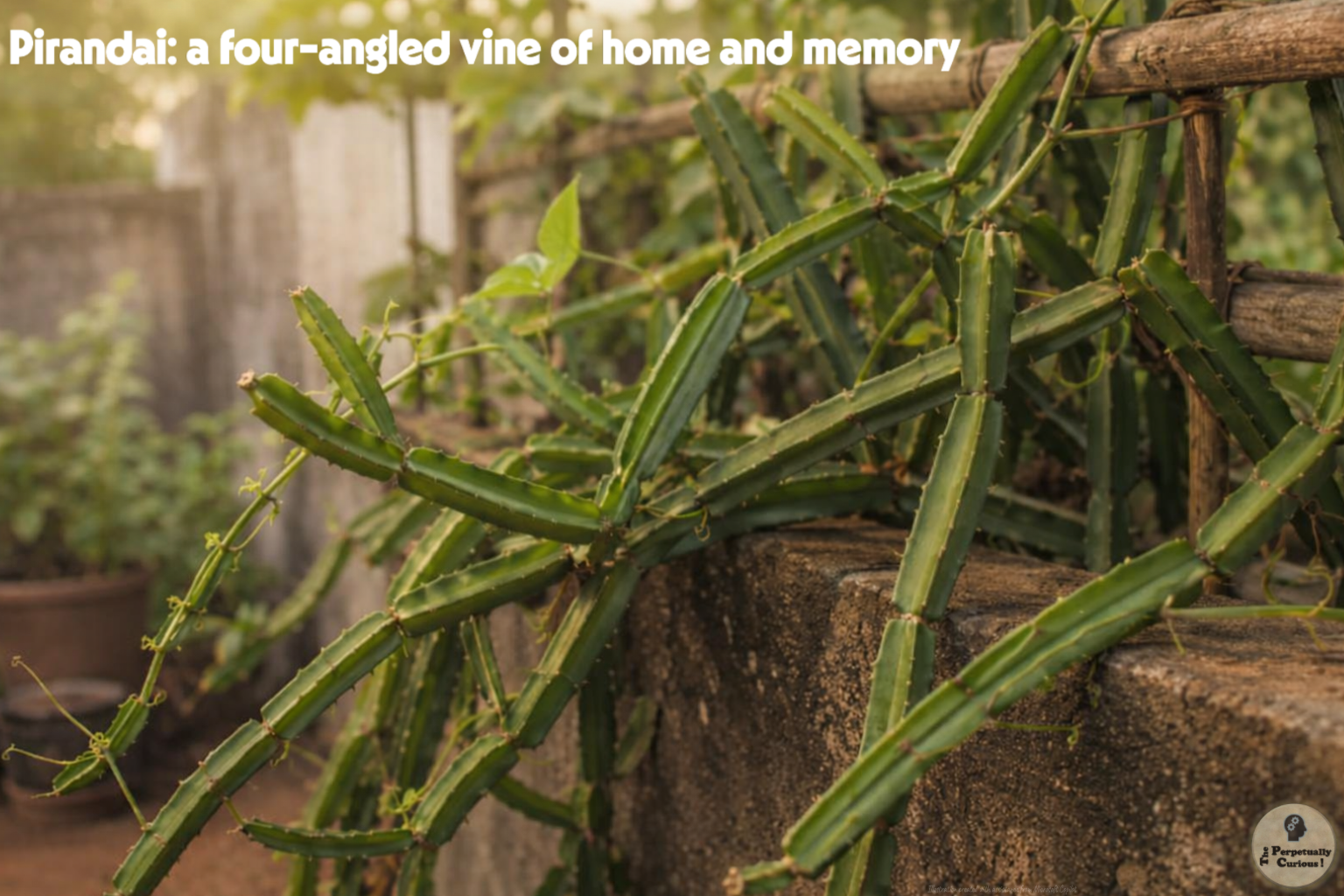
Along a warm garden fence, Pirandai does not announce itself through large flowers or dramatic leaves. It first catches attention through the strange discipline of its stem. Instead of a round, soft-looking vine, Cissus quadrangularis grows in firm green segments with four distinct angles. The plant climbs by tendrils, pauses at swollen nodes, and carries a geometry that feels almost architectural, as though the vine were built from small living beams.
That shape is more than a visual curiosity. Pirandai is a succulent climber, which means its stems can store moisture within their tissues. In dry, sunlit places, that stored water helps the plant remain active when surrounding vegetation may be waiting for rain. The four-sided structure also gives the vine a recognizable rhythm. Each segment becomes part of a living scaffold, allowing the plant to lean, grip, and continue upward without needing to become a tree.
Seen this way, Pirandai belongs to a wider botanical language of form and function. Plant shapes are rarely decorative alone. They carry traces of ancestry, climate, growth habit, and ecological pressure. A leaf, stem, tendril, or root can become a record of how a plant meets its world. That same habit of looking closely at living form appears in the study of plant geometry, where shape becomes a clue to development and adaptation.
When shape becomes memory
In home gardens, this geometry becomes familiar rather than abstract. Pirandai may run along a fence, climb a support, or settle into a boundary where cultivated space meets the rougher edge of the landscape. It does not need lush conditions to seem at home. Warmth, sunlight, and well drained soil suit it well, and its tolerance of dryness helps explain why it appears in semi-arid settings, rocky margins, and household gardens where usefulness and resilience often matter together.
The plant’s form has also shaped human interpretation. Across South Asia, Pirandai is known by several names, and some of them carry associations with bones, strength, and repair. The Sanskrit name Asthisamharaka is often interpreted in Ayurvedic literature as language connected with the joining of bones, while the Hindi name hadjod carries a similar cultural memory. Those names should not be treated as proof of a modern medical claim, but they do show how people often read meaning into visible form.
The larger version on our main site keeps that wider landscape intact, including the plant’s regional names, traditional contexts, scientific evidence, culinary uses, safety cautions, and source-grounded references. The central thread can begin more simply: Pirandai’s angular body gives people something concrete to notice before they encounter the broader history around it.
Useful, familiar, and still unfinished
In kitchens, the plant becomes sensory. Tender stems may be cleaned, cut, sautéed with spices, and ground into chutney or thogayal in some South Indian traditions. Cooking helps soften the sharper character of the raw plant, which some people associate with mild irritation or scratchiness. That everyday preparation places Pirandai in a practical household world rather than a purely symbolic one.
Modern research adds another layer, but it also asks for restraint. Studies have examined phytochemicals and possible biological activity in controlled settings, including preclinical work. Such findings can be interesting without becoming final. Human evidence remains limited, and personal health decisions belong with qualified professionals rather than with tradition alone or isolated laboratory findings.
What remains is a vine whose four angles gather several kinds of attention. To the gardener, it is a hardy climber. To the cook, it is a remembered ingredient. To the botanist, it is a distinctive succulent in the grape family. To the careful reader, it is a reminder that plant knowledge often begins with noticing one small form closely, then allowing the larger story to unfold with patience.
Comments
Post a Comment