

🌊 Niagara Falls Facts: How Water Turns Stone Into Time
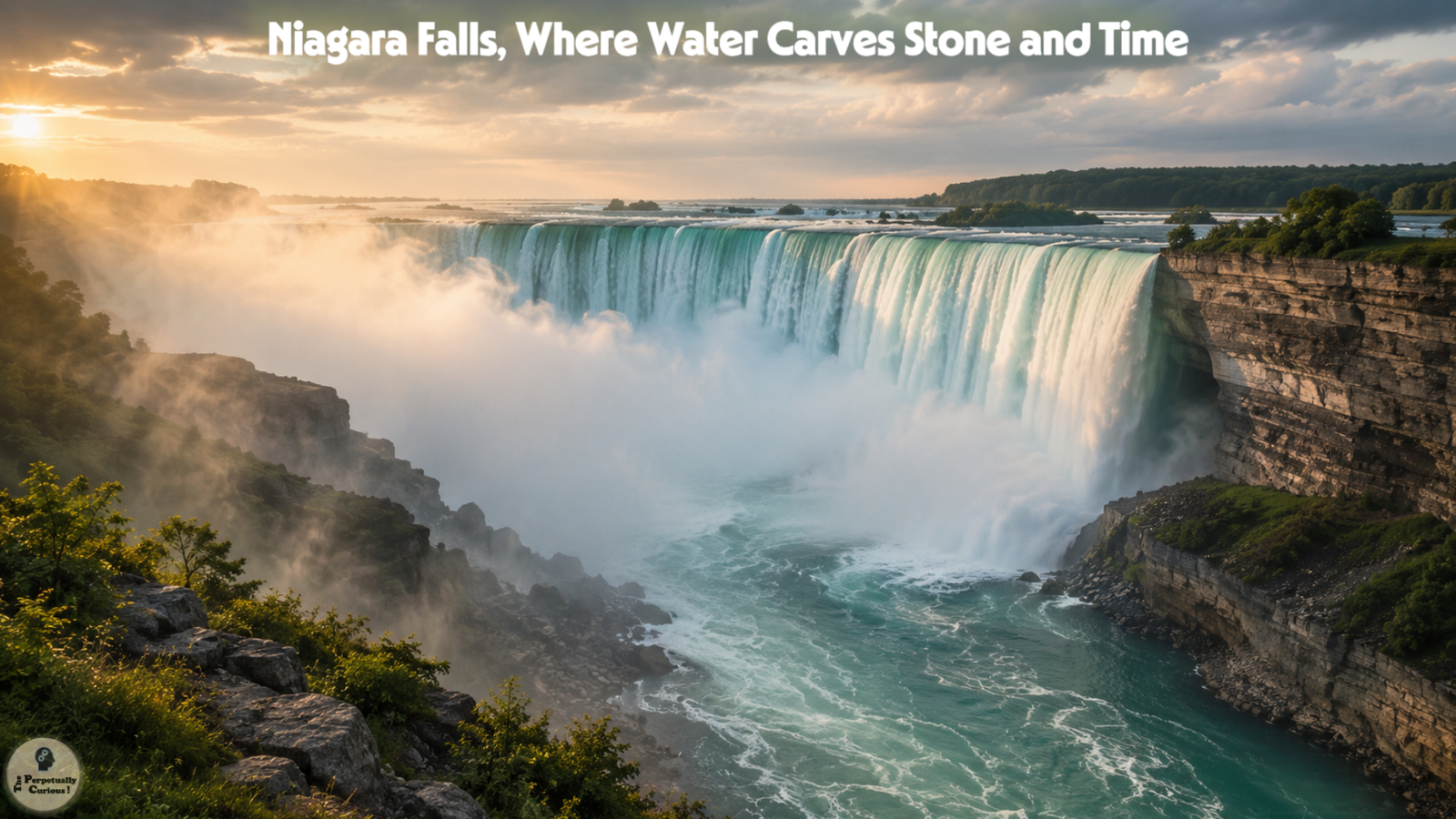
When Niagara Falls first appears through its mist, it can feel like a single spectacular drop. But the falls are better understood as a place where a much larger water system briefly becomes visible. The water is not arriving from nowhere. It belongs to a long drainage path that gathers through the upper Great Lakes, moves toward Lake Erie, and then passes through the Niagara River on its way to Lake Ontario and the St. Lawrence River.
A river carrying stored water
The Great Lakes system gives Niagara its hidden scale. These inland seas do not behave like a small stream responding only to the latest rainfall. They hold water across a vast basin shaped by ice, elevation, outlet channels, and time. By the time water reaches the Niagara River, it carries an inheritance left by retreating glaciers and by the slope between Lake Erie and Lake Ontario.
That glacial inheritance matters. Around the end of the last ice age, retreating ice opened basins, adjusted drainage routes, and left meltwater to find lower ground. One of those routes became the Niagara River. The falls are therefore not an isolated landmark placed beside the lakes. They are one visible threshold in a larger freshwater system, where stored inland water becomes motion, sound, spray, and erosion.
That setting explains why Niagara Falls is not defined by height alone. Horseshoe Falls drops about 188 feet (about 57 meters), but the impression comes from mass as much as distance. During peak daytime periods, more than about 6 million cubic feet of water per minute (about 168,000 cubic meters per minute) may cross the crest lines. The sound, spray, and shaking presence of the falls come from volume in motion.
Why the falls keep moving
The falls exist because the Niagara River meets the Niagara Escarpment, a ridge of layered sedimentary rock. Hard dolostone and limestone form a caprock above softer shale and sandstone. Falling water attacks these layers unevenly. Softer rock wears away faster, undermining the harder ledge above. Over time, pieces of caprock fracture, collapse, and reset the crest farther upstream.
As this cycle repeats, the waterfall retreats and the gorge lengthens. The steep walls downstream are not just scenery. They are a record of where the falls used to be. Each exposed layer, overhang, talus pile, and bend in the channel carries evidence of the same patient exchange between water and stone. The wider main-site treatment keeps that broader landscape intact, following Niagara beyond this water-and-rock lens into the three waterfalls, Indigenous presence, tourism history, hydropower regulation, ecosystems, winter ice, optical mist, FAQ details, and visual companions.
Mist as a sign of force
Mist may seem delicate, but at Niagara it is also a measurement of power. Water strikes the lower river with enough energy to break into fine droplets and rise as spray. Wind, temperature, sunlight, and gorge shape then decide how that spray drifts, thickens, glows, or vanishes. What visitors see as atmosphere is partly the visible afterlife of falling water.
The mist also softens the edge between geology and life. Moisture clings to gorge walls, gathers around vegetation, and changes how light reaches the scene. In that sense, Niagara is not only a waterfall. It is a small weather-maker, a rock-carver, a soundscape, and a moving boundary inside a continental drainage system.
Niagara works on two scales at once. In one moment, it is immediate: a brink, a plunge, a roar, and a cloud of spray. In the longer view, it is a moving edge within the Great Lakes outflow, steadily carving its own path through ancient rock. The falls feel fixed because human lives are short, but the gorge behind them shows otherwise. What looks like a monument is also a motion.
Comments
Post a Comment