

🏔️ Mount Kailash: Why a Sacred Summit Is Circled, Not Climbed
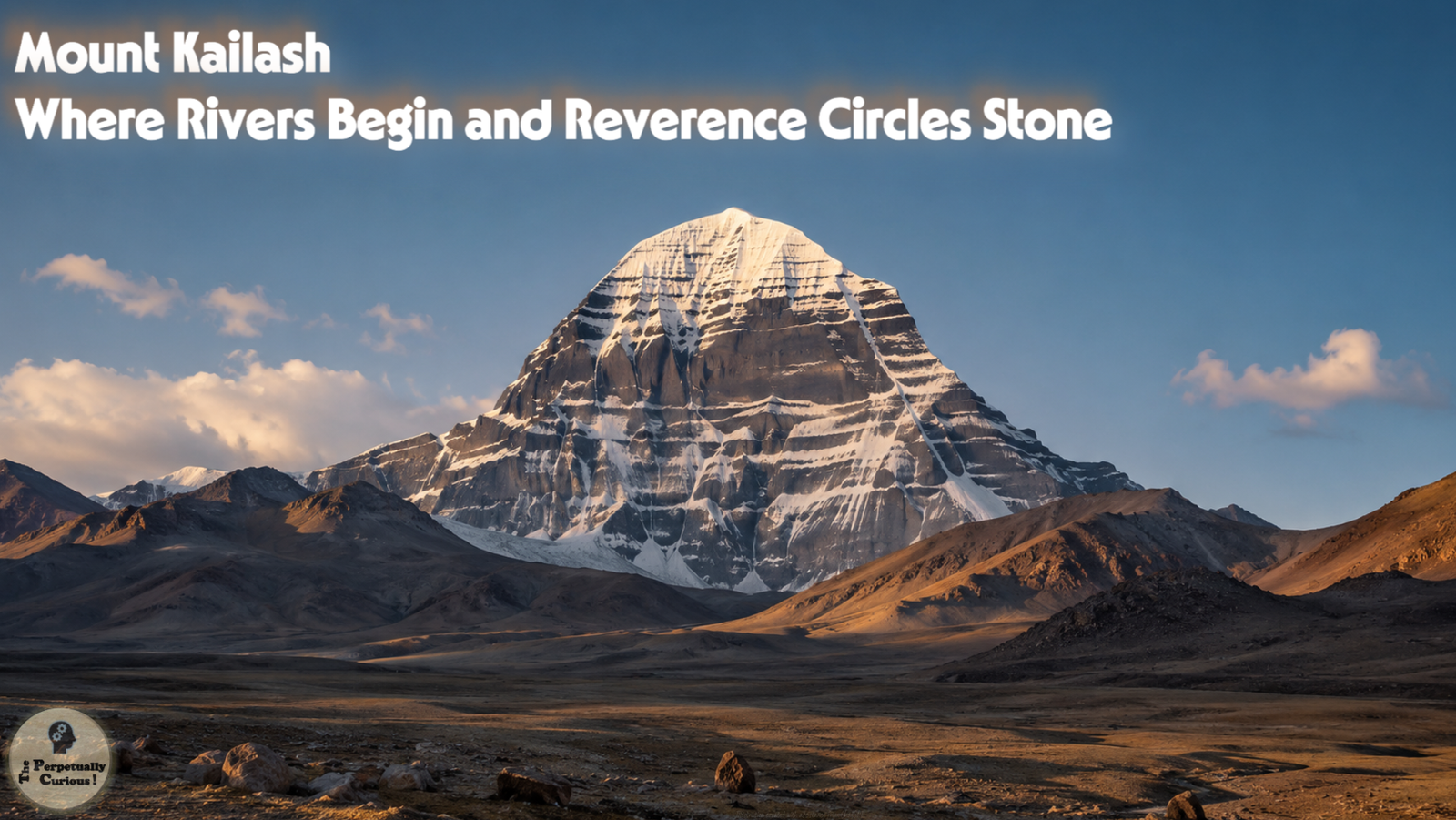
Mount Kailash is often described through reverence, but its power begins with geography. On the western Tibetan Plateau, the mountain rises as a sharply recognizable summit of snow, dark rock, and open sky. It is high, about 21,778 feet (6,638 meters), yet its significance does not come from being Asia's tallest peak. It comes from the way a single landform gathers water, movement, and meaning into one visible center.
Seen from a distance, Mount Kailash appears unusually self-contained. Its faces catch light in strong planes, and snow settles unevenly across ledges and ridges as wind and season reshape the surface. That physical presence matters. A mountain that stands apart from surrounding terrain becomes easier to recognize, remember, and orient around. In a sparse plateau landscape, form and distance can turn geology into a landmark.
A summit made powerful by position
Mount Kailash stands in a region where the high plateau feels both open and severe. Thin air, strong sunlight, cold temperatures, and sparse vegetation shape the surrounding environment. The nearby lakes, including Manasarovar and Rakshastal, add another layer to the setting, placing water, reflection, salt, and freshwater contrast close to the mountain's slopes without reducing the place to scenery alone.
Its setting also belongs naturally within the wider Planet Earth collection, where mountains, rivers, geology, and extreme landscapes are treated as connected parts of Earth's physical story.
The same region is tied to the early courses or headwaters of several major river systems, including the Indus, Sutlej, Karnali, and Yarlung Tsangpo Brahmaputra systems. That does not mean all water begins at the summit itself. The deeper point is geographic: this part of the Tibetan Plateau helps send water outward across immense distances, linking a remote mountain landscape to plains, valleys, and deltas far beyond view.
Water moves outward, meaning gathers inward
The direction of water is only one half of the pattern. Human meaning moves the other way, toward the mountain. Mount Kailash is revered in Hindu, Buddhist, Jain, and Bon traditions, each with distinct narratives and ritual understandings. Those traditions should not be flattened into one story. What they share is a recognition that the mountain holds a central place in sacred geography.
That cultural layer also connects with the broader History, Arts & Culture collection, where places are often shaped not only by terrain, but by memory, ritual, symbol, and inherited meaning.
The practice most closely associated with the mountain is not climbing, but circling. The Kailash Kora follows a route around the mountain, turning reverence into movement. A circle changes the relationship between person and peak. The summit is not conquered or crossed. It remains at the center while the traveler moves around it, seeing new faces of stone, snow, shadow, and sky.
That larger path continues in a quieter way on our main site, where the lakes, river geography, religious traditions, geology, access context, environmental setting, and visual materials have room to unfold without being compressed here.
A mountain approached by distance
Mount Kailash has no recorded ascent, and climbing is prohibited. That restraint is central to the mountain's modern identity. Many famous peaks are known because humans have reached their summits. Kailash is known partly because people have not. Its meaning is shaped by presence, distance, and circumambulation rather than by conquest.
This makes Mount Kailash an unusual meeting point between physical geography and cultural memory. Rock, snow, rivers, lakes, pilgrimage, and interpretation all gather around one form. The mountain remains a real summit in a high altitude landscape, shaped by tectonic history, wind, ice, and erosion. Yet it is also a place where people have long imagined center, origin, stillness, and return.
The core idea is a quiet pattern: water flows away, travelers circle near, and meaning gathers around a summit that remains beyond ascent. Mount Kailash is not approached as a prize to be taken, but as a center to be recognized from many sides.
Comments
Post a Comment