


💡 How an Incandescent Filament Turns Resistance into Warm Light
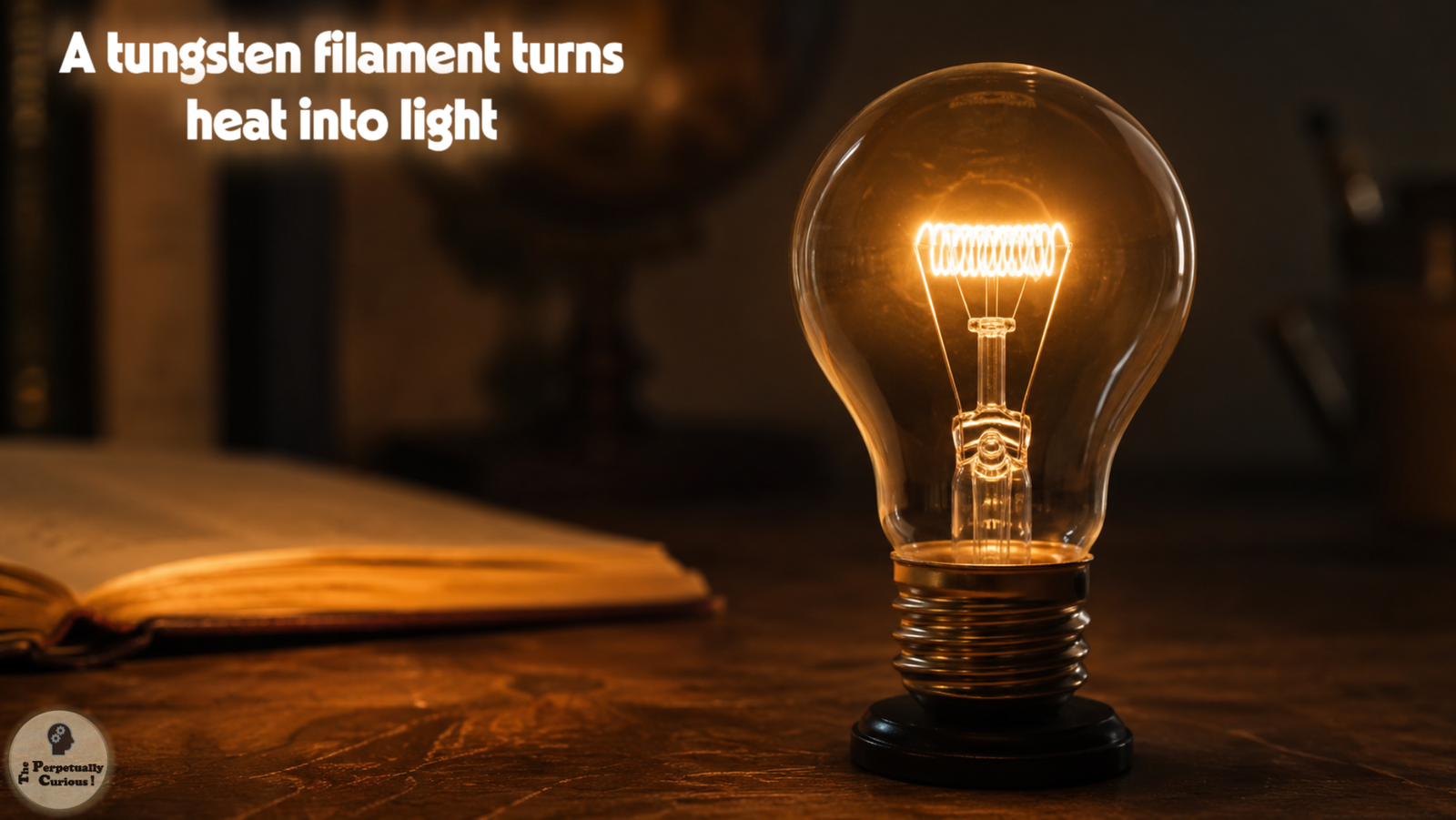
An incandescent bulb seems to awaken all at once. The switch closes, the filament brightens, and a room takes on a warm amber cast. Inside the glass, however, the change is not sudden magic. It is a rapid physical sequence in which electrical current meets a deliberately narrow path, the metal grows intensely hot, and part of that heat becomes visible to the eye.
A current meets a narrow metal path
The central event happens in the tungsten filament. Current enters through the bulb’s contacts and moves along a wire far thinner than the conductors that carry electricity through the rest of the circuit. Tungsten does not allow charge to move without resistance. Interactions within the metal impede the current and transfer electrical energy into the filament’s atomic lattice, increasing its thermal motion.
That process is often described simply as resistance heating, but the scale matters. The filament is not heated to the temperature of a stove or fireplace. It commonly operates near 4,500°F (about 2,500°C), hot enough for the metal to radiate strongly across a broad range of wavelengths. Tungsten is suited to this severe task because its melting point is about 6,190°F (3,420°C), allowing the wire to remain solid while glowing intensely.
When heat enters the visible spectrum
All matter above absolute zero emits thermal radiation. At ordinary temperatures, nearly all of that radiation lies beyond human vision in the infrared. As an object becomes hotter, its emission grows stronger and shifts toward shorter wavelengths. A filament therefore begins by radiating mainly invisible heat. With increasing temperature, a faint red glow appears, followed by orange and then yellowish-white light as more of the spectrum enters the visible range.
Incandescence is the name for this production of visible light by heat. The bulb does not contain a separate substance that turns electricity into brightness. The tungsten itself becomes luminous because its temperature is high enough for thermal radiation to reach the eye. This dependence on extreme heat separates incandescent light from firefly bioluminescence, where a controlled chemical reaction produces photons with very little accompanying warmth.
The temperature settles when the electrical power entering the filament is balanced by the energy leaving it through radiation, conduction into the support wires, and heat transfer to the surrounding environment. This balance is dynamic rather than motionless. The current keeps supplying energy while the filament continuously releases it, allowing the wire to remain at a nearly steady luminous temperature until the circuit is opened.
Why the glow remains warm
The filament’s temperature also explains why the light feels warm in color. An ordinary incandescent bulb emits a continuous spectrum, but its visible output is weighted more heavily toward reds and yellows than toward blues. The result is the familiar golden tone associated with evening lamps, candles, and firelight. Lowering the electrical power with a dimmer cools the filament, so the bulb becomes both fainter and redder rather than merely producing less of the same light.
The same spectrum reveals the limitation of the design. Much of the filament’s radiation remains infrared, so only a modest part of the electrical input becomes light that human vision can use efficiently. The warmth felt near an operating bulb is not incidental. It is inseparable from the mechanism that makes the filament shine.
Beyond the filament’s first glow, the complete article on our main site keeps the bulb’s whole engineered environment in view, including its coiled geometry, protective gas, glass envelope, energy losses, gradual aging, and the later shift from hot metal to semiconductor light.
A glowing filament is therefore a visible threshold. Below it, electrical energy is mostly felt as heat. Above it, the same heated matter begins to announce its temperature through color. The bulb makes that transition familiar enough to overlook, yet each warm pool of light still carries the signature of metal held close to its physical limits.
Comments
Post a Comment