
🌍 How Earth Formed: The Slow Assembly of a Young Rocky World
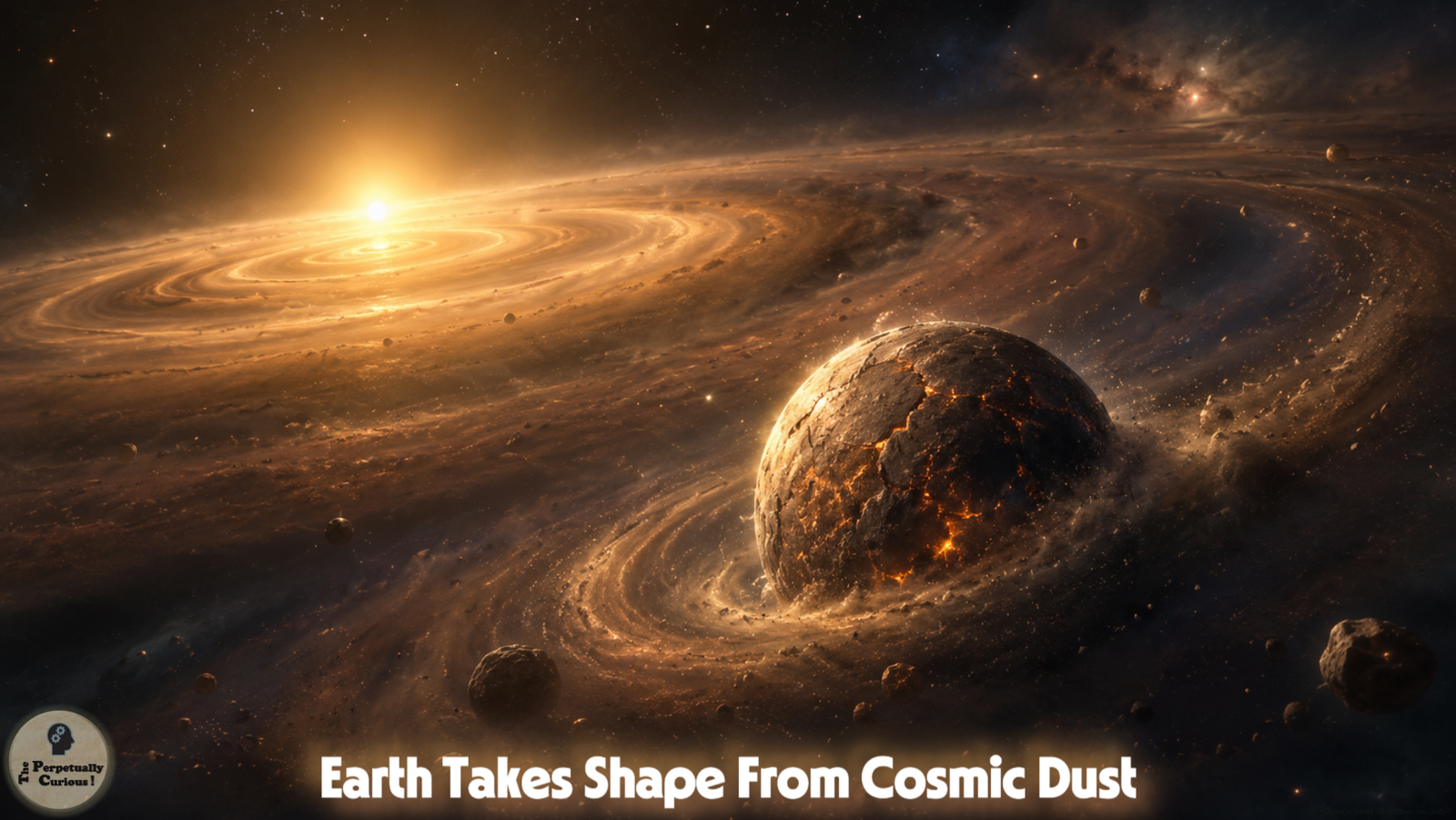
Earth did not appear as a finished sphere in an otherwise complete Solar System. Its beginning was distributed across a rotating disk of gas, dust, rock, and metal around the newborn Sun. In the warmer inner part of that disk, where Earth would eventually orbit, solid rocky material could persist more readily than the light gases and ices that were abundant farther out.
There was no single moment when scattered material suddenly became a planet. Earth formed through accretion, a long process in which small pieces met, combined, and gradually built larger bodies. The planet beneath us began as a population of separate particles moving through a crowded and changing environment.
A Disk With No Finished Planets
Tiny dust grains in the protoplanetary disk collided and sometimes remained together. Repeated encounters produced larger aggregates, and continued growth eventually created kilometer-scale bodies called planetesimals. These were not miniature finished planets. They were early building blocks whose orbits could be altered by collisions and by the gravity of surrounding objects.
Some planetesimals merged into larger protoplanets. In the region near Earth’s present orbit, one growing body became proto-Earth. As it gained mass, its gravitational influence strengthened, making further encounters with nearby material increasingly important. Each successful collision added matter, but it also released energy. Planetary growth was therefore both constructive and violent.
The early Solar System contained several substantial bodies moving through overlapping neighborhoods. Some collided and merged. Others broke apart, scattered smaller objects, or were pushed onto different paths. Across tens of millions of years, these interactions reduced the number of large bodies near Earth’s orbit and concentrated more material into the growing proto-Earth.
When Gravity Began to Amplify Growth
Accretion changed more than Earth’s size. A larger world exerted a stronger gravitational pull and could participate in increasingly energetic collisions. The same process that gathered material also supplied heat and pressure, preparing the young planet for later changes within its interior.
This is why Earth’s age does not describe one clean birthday. The planet formed within a broad window. It gained much of its mass early, but its development continued through major impacts, internal reorganization, surface cooling, and the gradual emergence of conditions very different from those in the original disk.
On the scale of a galactic year, roughly 230 million Earth years, most of Earth’s assembly occupied only an early portion of its first orbit around the Milky Way. That comparison does not replace the planetary timeline, but it shows how rapidly the main growth phase occurred against the deeper motion of the Solar System through the galaxy.
The broader main-site treatment follows what this growing mass made possible, including Earth’s layered interior, the Moon-forming impact, the cooling surface, early atmosphere, oceans, and the evidence scientists use to reconstruct a beginning that left few direct records.
A Planet Built Through Continuity
The word formation can sound like a single event, as though Earth crossed a precise boundary and became complete. The physical story is more gradual. Dust became aggregates. Some aggregates contributed to planetesimals. Planetesimals and protoplanets collided, merged, scattered, and changed one another’s paths. From that extended sequence, proto-Earth emerged as a substantial young world.
Later chapters would transform it profoundly, but they depended on this first accumulation of material. Without enough mass, Earth could not have developed the pressure, heat, and gravity that shaped its subsequent evolution. Accretion provided the substance of the planet and the energy that carried it into its next state.
The finished Earth was never waiting inside a single grain of cosmic dust. It arose from countless encounters, each small compared with a planet, yet together capable of building one. The world beneath our feet began not with a solitary creation moment, but with matter gathering patiently through motion, collision, and gravity.
Comments
Post a Comment