🌫️ Why the Great Smoky Mountains Fade into Blue Haze
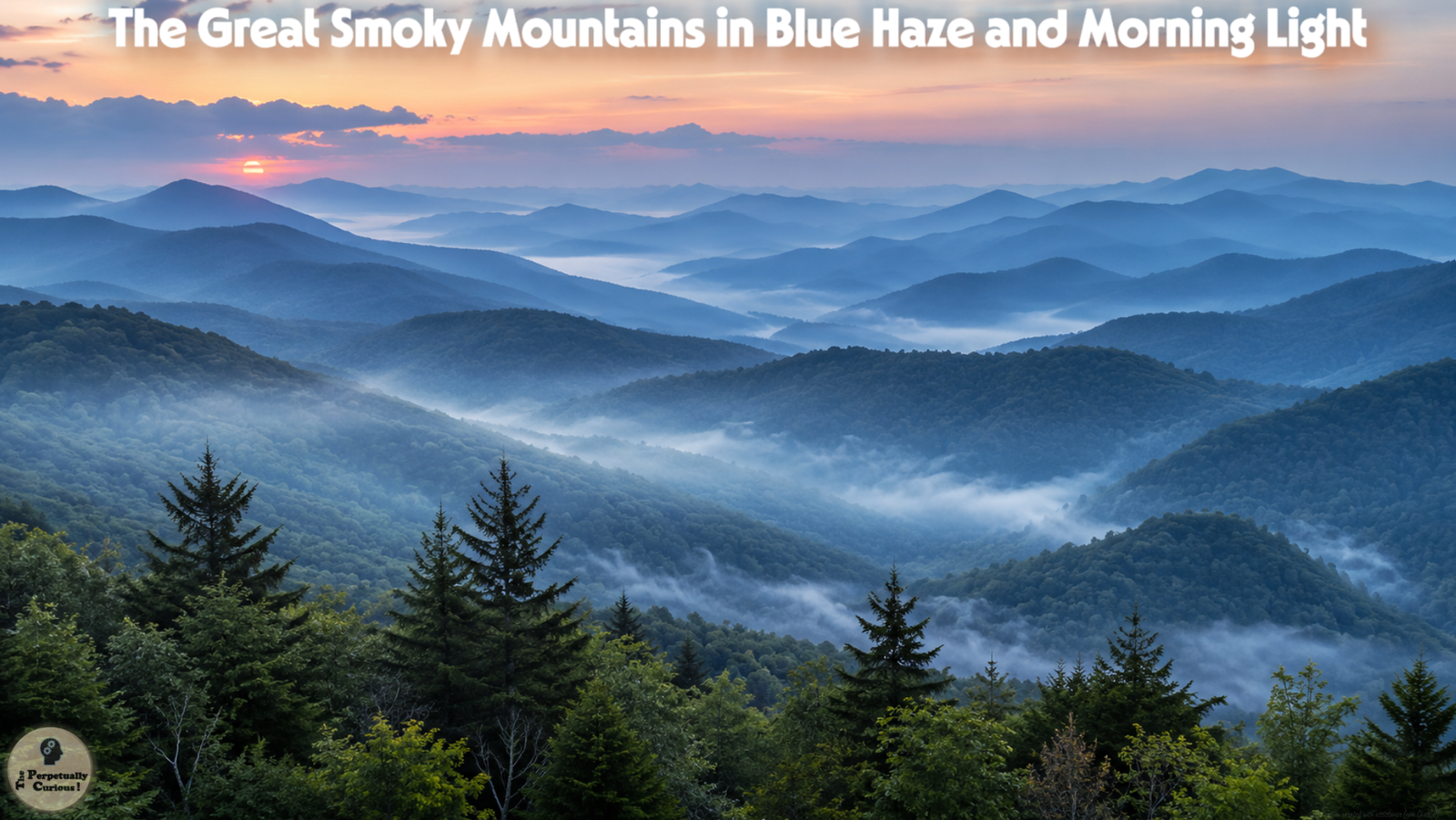
At dawn, the Great Smoky Mountains can appear less like a wall of peaks than a sequence of blue shadows. Ridge after ridge fades into the distance, while the valleys seem to hold smoke even when no fire is burning. The effect is one of the region's defining sights, but the name “Smoky” begins with a quiet interaction among trees, moisture, airborne particles, and sunlight.
The forest helps make the haze
A forest is not chemically silent. Leaves release volatile organic compounds as part of normal plant activity. Once these compounds enter the air, some react with oxygen and other atmospheric chemicals, contributing to extremely small organic particles that remain suspended as aerosols. Above broad forested slopes, these particles become part of the atmosphere through which distant ridges are seen.
The result is different from a column of smoke. There may be no burning source and no single plume. Instead, countless trees contribute small amounts of material across a wide landscape. Warmth, humidity, airflow, and the density of vegetation influence how much haze becomes visible from one day to another.
Moisture strengthens the softened appearance. Humid air can allow fine particles to take up water and become more effective at scattering light. Mist and low cloud may also settle into valleys, adding pale moving layers beneath the more diffuse blue cast of the distant mountains. The atmosphere can therefore hold several forms of softness at once.
Why the ridges look blue
Distance is essential to the effect. Every ridge viewed across a valley is seen through a deeper layer of air than the ridge before it. Fine particles and molecules redirect some of the incoming sunlight, and shorter blue wavelengths are scattered efficiently toward the observer. As more atmosphere enters the line of sight, contrast decreases, details fade, and the farthest slopes appear increasingly blue.
The same family of physics appears in the way air scatters sunlight, although the viewing geometry here produces a cool veil across distant land rather than the warm filtering of a sunset. The mountains are not themselves blue. Their color is partly an atmospheric image formed between the forested slopes and the person looking toward them.
Fog, natural haze, and pollution can overlap visually, but they are not identical. Fog consists mainly of suspended water droplets and often looks white or gray at close range. The natural forest haze is usually broader and more diffuse. Air pollution can add another whitish layer, reducing clarity and sometimes weakening the characteristic blue depth. A hazy view can therefore contain both natural and human-influenced components.
The broader Smokies narrative on our main site follows this atmosphere into ancient Appalachian geology, elevation-shaped forests, streams, biodiversity, Cherokee homelands, Appalachian communities, and the continuing work of conservation.
A landscape that seems to breathe
The blue haze is not a permanent curtain. It shifts with sunlight, rain, temperature, wind, and humidity. Morning moisture may collect in the valleys, while stronger daylight reveals separate ridgelines. After changing weather, the same overlook can move from sharply defined slopes to soft layers that seem to dissolve into the sky.
That variability helps explain why the Smokies often feel alive. The visible landscape is being redrawn from hour to hour by processes that are ordinary on their own: leaves releasing compounds, water entering the air, particles remaining suspended, and sunlight traveling through them. Together they create an appearance that can feel almost animate.
What looks like smoke above the ancient ridges is therefore not one substance or one event. It is a meeting of forest chemistry, mountain moisture, distance, and light. The mountains carry the color, but the atmosphere completes the view.
Comments
Post a Comment