


🐘 Elephant Intelligence: How Memory Becomes a Family Inheritance
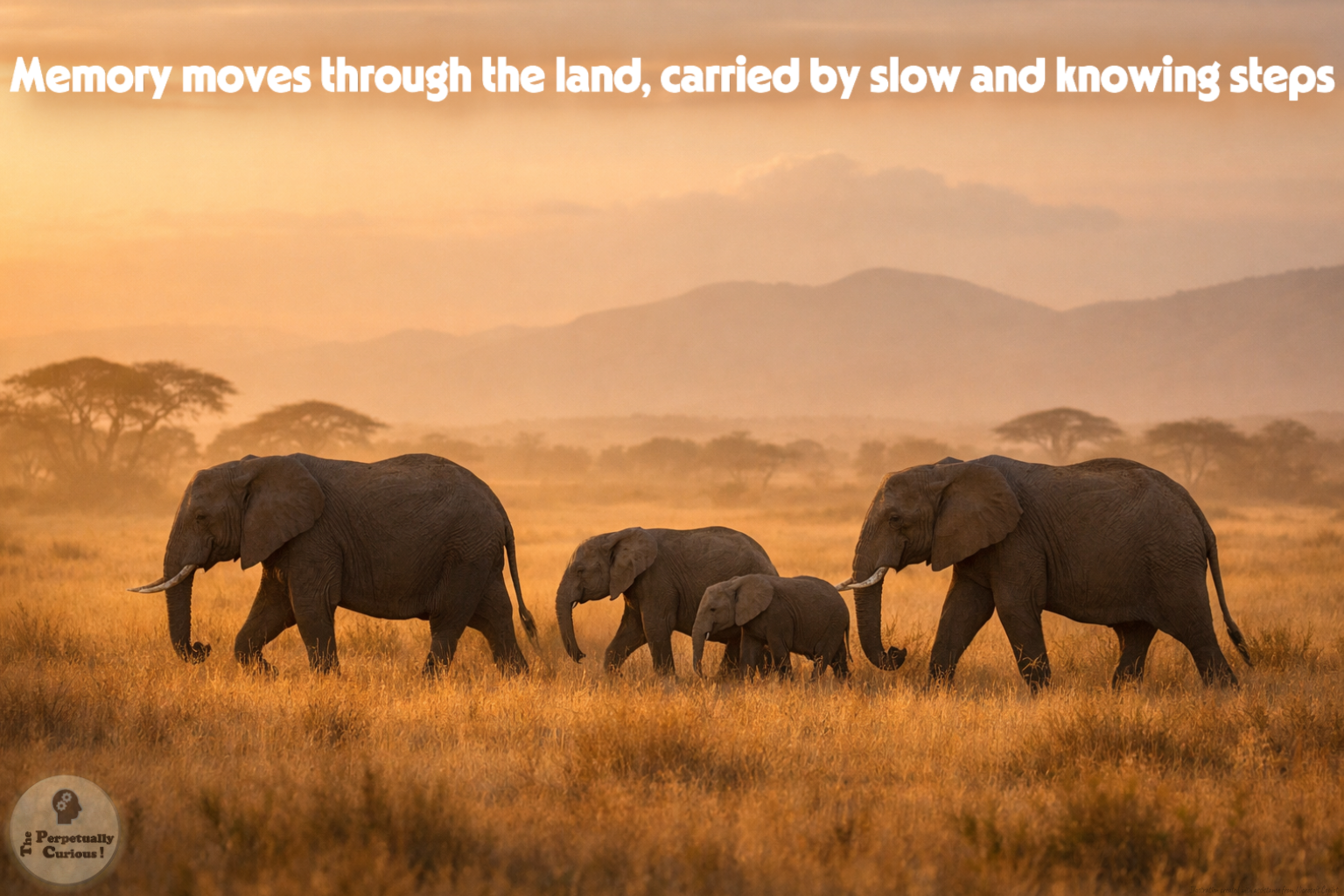
At the edge of a difficult season, an elephant family may leave familiar ground and follow an older female toward water remembered from years before. No map is carried, and no route is explained aloud. Yet the herd’s movement can reflect accumulated experience: where water once remained, which paths were passable, and where danger was encountered.
This is one of the clearest ways to understand elephant intelligence. Memory is not only held by an individual mind. Within a family, it can become a shared survival resource, carried through relationships and renewed as younger elephants travel beside older ones.
When Memory Becomes Movement
Elephants often range across large and changing landscapes. During dry periods, experienced matriarchs may guide family groups along routes connected with earlier water sources, feeding areas, or safer resting places. Their choices are shaped by terrain and present conditions, but also by what years of movement have taught them.
Spatial memory becomes visible through action. A remembered place matters because it can influence when the herd turns, where it pauses, and how it responds when familiar conditions have changed. The older elephant is not simply retrieving a fixed route. She must also weigh current scent, sound, weather, group condition, and risk.
That flexibility matters. Strong memory does not mean that elephants follow the past without adjustment. Landscapes shift, water disappears, and human activity can alter familiar paths. Intelligence includes using stored knowledge while remaining responsive to the world as it is now.
A Long Childhood Inside a Living Network
Elephant calves spend years near mothers, siblings, aunts, and other herd members. This long period of dependence gives them time to learn far more than basic movement. They gradually refine trunk control, recognize social signals, follow group rhythms, and observe how experienced elephants respond to unfamiliar sounds, difficult crossings, and possible threats.
Care also extends beyond the mother. Allomothers and older relatives may guide calves, keep them within the group, or help shield them during travel. When adults position themselves around younger elephants, protection and learning occur together. The calf is not only being kept safe. It is also experiencing how the family organizes itself when conditions demand coordination.
A related pattern appears in extended childhood and social learning among great apes, where young animals also acquire practical and social knowledge through prolonged contact with experienced caregivers. The species differ greatly, but both illustrate a broad principle: complex lives often require time to learn.
The broader account of elephant intelligence on our main site follows this family-based memory into sensory perception, low-frequency communication, problem solving, emotional responses, and the ecological pressures that shape elephant decisions.
Knowledge Carried Without a Classroom
Elephants do not teach through formal lessons, yet knowledge can pass through repeated journeys, observation, touch, vocal signals, and participation. A calf follows the same route more than once. It watches how adults approach water, react to unfamiliar calls, or gather around a distressed herd member. Over time, these experiences become part of its own working knowledge.
This does not mean that every repeated behavior should automatically be called culture. Researchers continue to examine how migration routes, foraging practices, and communication patterns are transmitted, and careful interpretation remains important. Still, the role of older elephants is difficult to separate from the survival knowledge available to the group.
Seen through this lens, elephant intelligence is not defined only by brain size or isolated problem-solving feats. It is also a social process shaped by long lives, durable bonds, and landscapes remembered together. When a herd moves across open ground, memory becomes more than recollection. It becomes guidance, protection, and a path that younger elephants may one day carry forward.
Comments
Post a Comment