
🌘 Eclipses Across the Solar System: When Shadows Travel
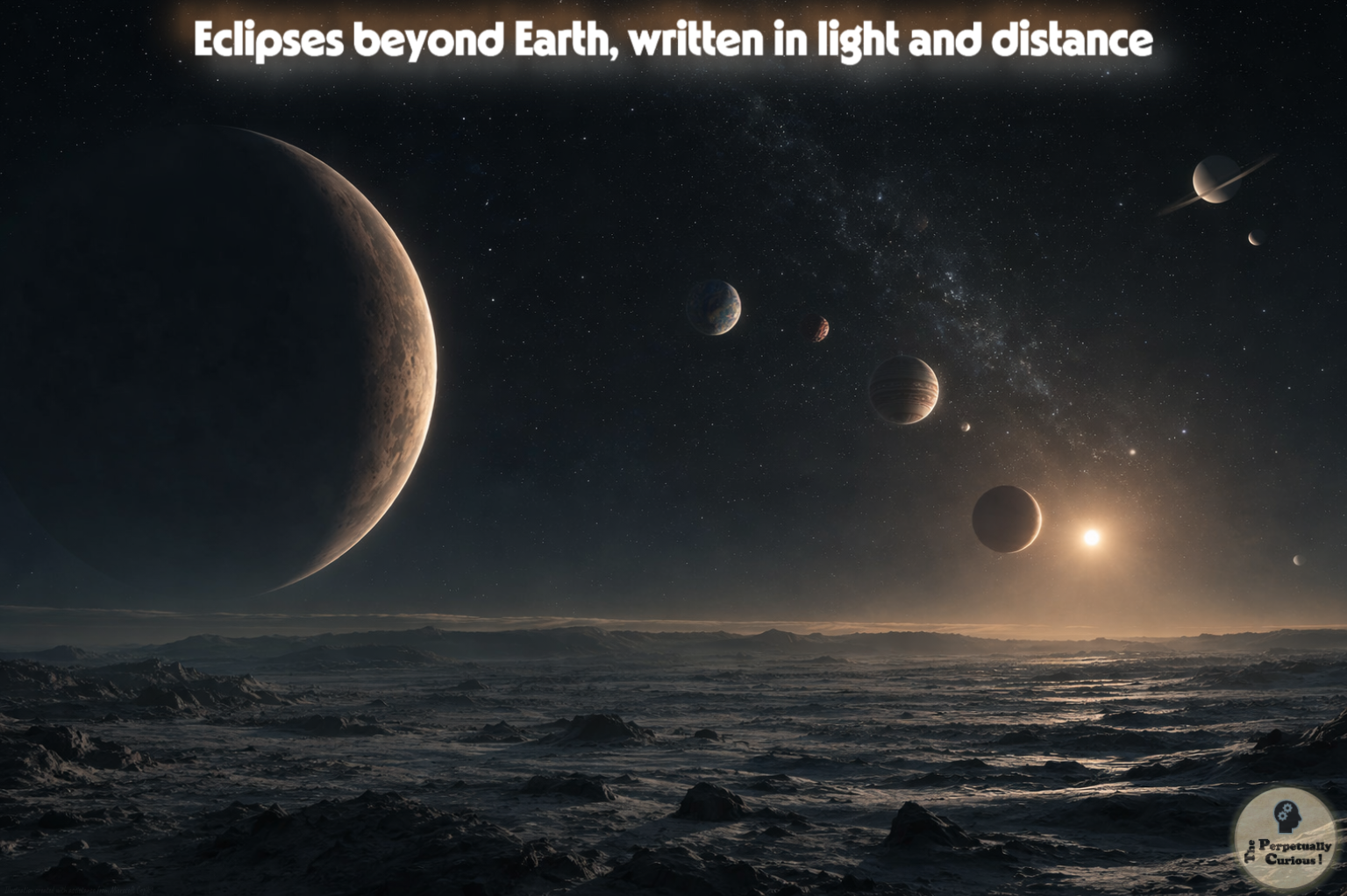
An eclipse can feel like a rare celestial exception, but the underlying arrangement is simple. A light source shines, one world blocks that light, and another surface receives the shadow. On Earth, the Sun, Moon, and our planet create the examples we know best. Across the Solar System, the same geometry repeats with different planets, moons, rings, distances, and atmospheres.
A simple alignment, many possible shadows
The basic distinction depends on which body receives the shadow. In a solar eclipse, a moon passes between its planet and the Sun. In a lunar eclipse, a moon moves into the shadow of its planet. Both depend on alignment, but the visual result depends on scale. A large nearby moon may hide the Sun completely. A small or distant moon may appear only as a dark dot crossing the solar disk. A planet with a deep shadow can darken its moons for hours, while a thin penumbral crossing may barely dim the surface.
The shadow itself has structure. The umbra is the deepest region, where direct sunlight is fully blocked. The penumbra is softer, where only part of the Sun is covered. Apparent size matters as much as actual size, because the same moon can look large or small depending on where the observer stands. That is why eclipses beyond Earth are not simply copies of the familiar sky. They are local events shaped by local geometry.
To see how this shadow logic plays out world by world, the main-site article follows the wider path through Martian moon transits, Jupiter’s moving shadow spots, Saturn’s ring shadows, Titan’s haze, Triton’s distant eclipses, and the observation history behind these rare alignments. Here, the narrower idea is the way one simple alignment can change character as soon as the setting changes.
How moons turn geometry into experience
Moons are the main shadow makers in this story. Mars shows the delicate end of the spectrum. Phobos and Deimos are too small to cover the Sun completely from the Martian surface, so they create brief transits rather than full solar eclipses. Their silhouettes can still interrupt the light, but the experience is quick and spare, closer to a moving mark across the Sun than a darkened day.
Jupiter offers a stronger contrast. Its large moons can cast dark spots across the planet’s cloud tops, and the scale of the system allows shadows to move like visible geometry across an enormous atmosphere. From some moons, Jupiter itself would become the eclipsing body, filling the sky and blocking sunlight for far longer than a small moon could. The broader family of lesser known moons also matters here, because smaller companions, tilted orbits, and unusual paths help show how varied moon systems can become.
Farther outward, distance changes the mood. The Sun appears smaller from Uranus, Neptune, Pluto, and their moons, so the same act of blocking sunlight can feel quieter and colder. Triton, Neptune’s large moon, can still experience a deep solar eclipse because Triton can appear much larger than the distant Sun from that local sky. Its thin atmosphere would scatter little light, making the boundary between sunlight and shadow more crisp than hazy.
Atmosphere, rings, and distance
Eclipses also reveal the medium through which light travels. Titan, Saturn’s largest moon, has a thick haze that would soften and tint an eclipse. A moon without much atmosphere would experience a sharper edge, while a world with clouds, haze, or scattered particles may turn the same geometry into a muted wash of color. Saturn adds another layer because its rings cast broad shadows across the planet, creating moving bands of interrupted light rather than the familiar pattern of one moon and one shadow.
This is the quiet beauty of eclipses across the Solar System. The rule is simple, but the setting changes everything. A small Martian moon, a giant planet’s cloud tops, a hazy Saturnian sky, and an icy outer moon all answer the same geometry in different voices. The shadow is never only darkness. It is a measurement of distance, motion, atmosphere, and scale, briefly written across a world.
Comments
Post a Comment