
🌌 Constellations: How Star Patterns Help Us Find Our Way
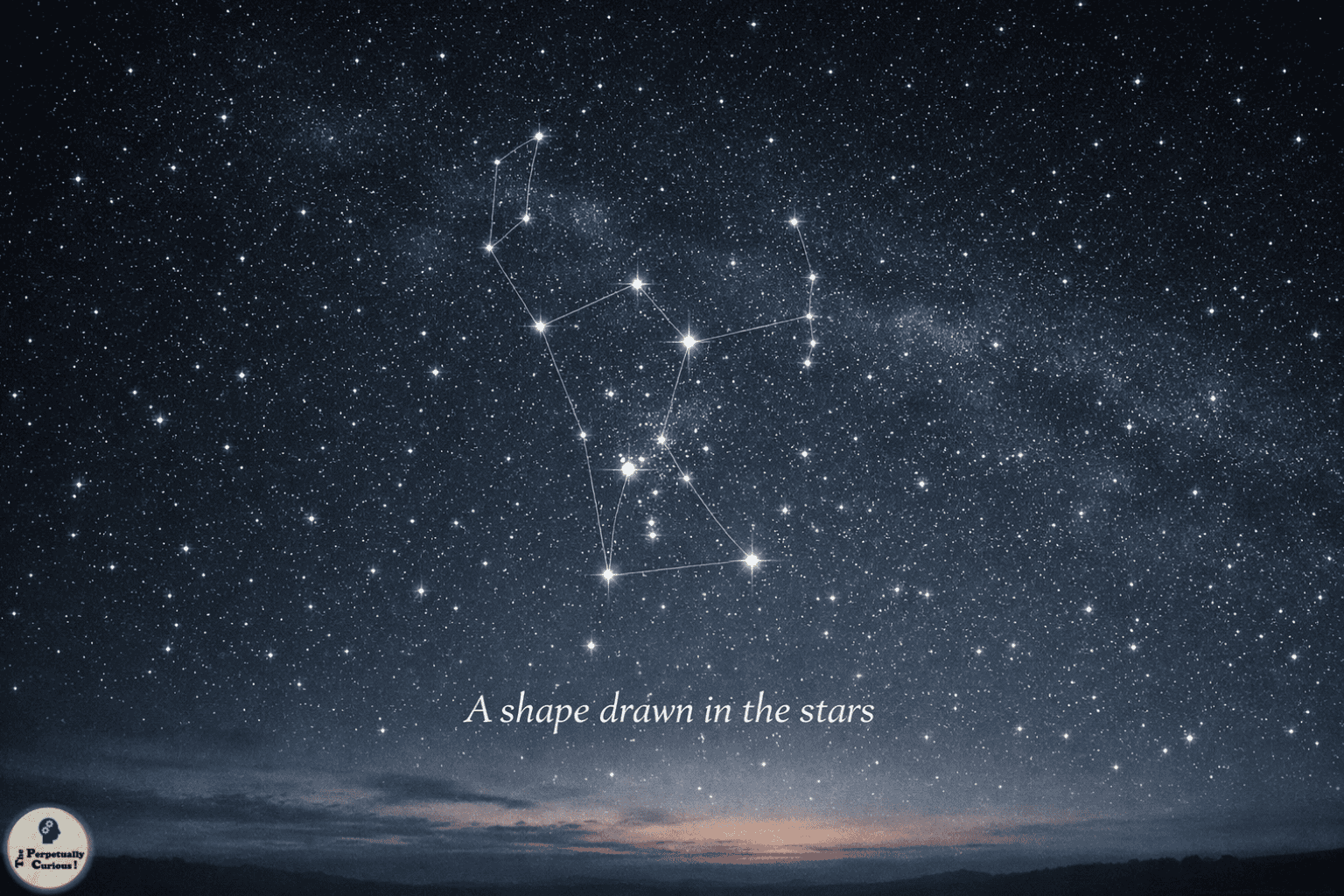
At first glance, constellations look like drawings placed gently across the night. A hunter, a cross, a scorpion, a bear, or a bright line of stars can seem almost intentional, as though the sky itself has arranged symbols for us to find. Yet their usefulness begins with a simpler human act: the mind remembers patterns.
When scattered stars become a map
A constellation is not usually a real cluster of neighboring stars. Many of the stars that seem close together from Earth are separated by enormous distances. They share a direction in our sky rather than a common home in space. Modern astronomy goes even further, treating official constellations as defined regions of the celestial sphere, not just picture-like outlines.
That distinction makes constellations more interesting, not less. A pattern does not need to be physically connected to be useful. A map does not become meaningless because the roads, rivers, and towns printed on it are not made of ink in the real world. In the same way, constellations turn a field of scattered light into a remembered frame. They help the eye return to the same part of the sky again.
The darkness around the stars matters too. Without contrast, the points of light would not stand apart so clearly. That neighboring question of why the sky can appear dark while the universe is filled with light is followed in why space looks dark, where the focus shifts from remembered patterns to visibility itself.
Why orientation needs memory
Long before digital maps and precise instruments, the sky was a practical companion. A constellation rising before dawn could mark the approach of a season. A familiar pattern near the pole could help hold direction through the night. A bright line of stars could guide the eye toward another part of the sky. These repeated appearances turned the heavens into a clock, calendar, and compass.
This is why constellations often belong to both science and culture. Their movements reflect Earth's rotation and orbit, but their names and shapes come from human communities. A sailor, a farmer, a traveler, and a storyteller might all look upward and find different kinds of usefulness in the same sky. The pattern was visible, but the meaning was learned.
For the wider trail on our main site, the discussion opens beyond orientation into cultural sky traditions, the eighty-eight official regions of modern astronomy, changing stellar motion, and FAQ-level distinctions. Here, the focus stays with the first act of recognition: seeing a pattern, remembering it, and using it to find a way through darkness.
The quiet usefulness of an imperfect pattern
That first act still matters. Even today, many observers learn the sky by starting with a few dependable shapes. Orion can help beginners recognize a winter sky in northern midlatitudes. The Southern Cross can help locate the approximate direction of the south celestial pole in the Southern Hemisphere. The Big Dipper, an asterism within Ursa Major, can lead the eye toward Polaris in the north.
These patterns are not permanent in the deepest sense. Stars move slowly through the galaxy, and over long spans of time the outlines we know will stretch, soften, or disappear. Earth's axis also changes direction gradually through precession, shifting the long-term relationship between pole stars and navigation. What feels fixed to a human lifetime is still part of a moving universe.
That gentle tension is part of the beauty of constellations. They are temporary enough to belong to cosmic motion, yet stable enough to guide memory across generations. They show how people turn perception into knowledge, and how knowledge becomes part of culture.
A constellation is therefore more than a sketch in the sky. It is a meeting point between sight and story, between Earth's motion and human memory, between the need to travel and the wish to understand. The stars are distant, separate, and restless, but from here they still gather into patterns that help us look up and find our place.
Comments
Post a Comment