
🌌 Why Space Looks Dark: Light, Matter, and the Quiet Cosmos
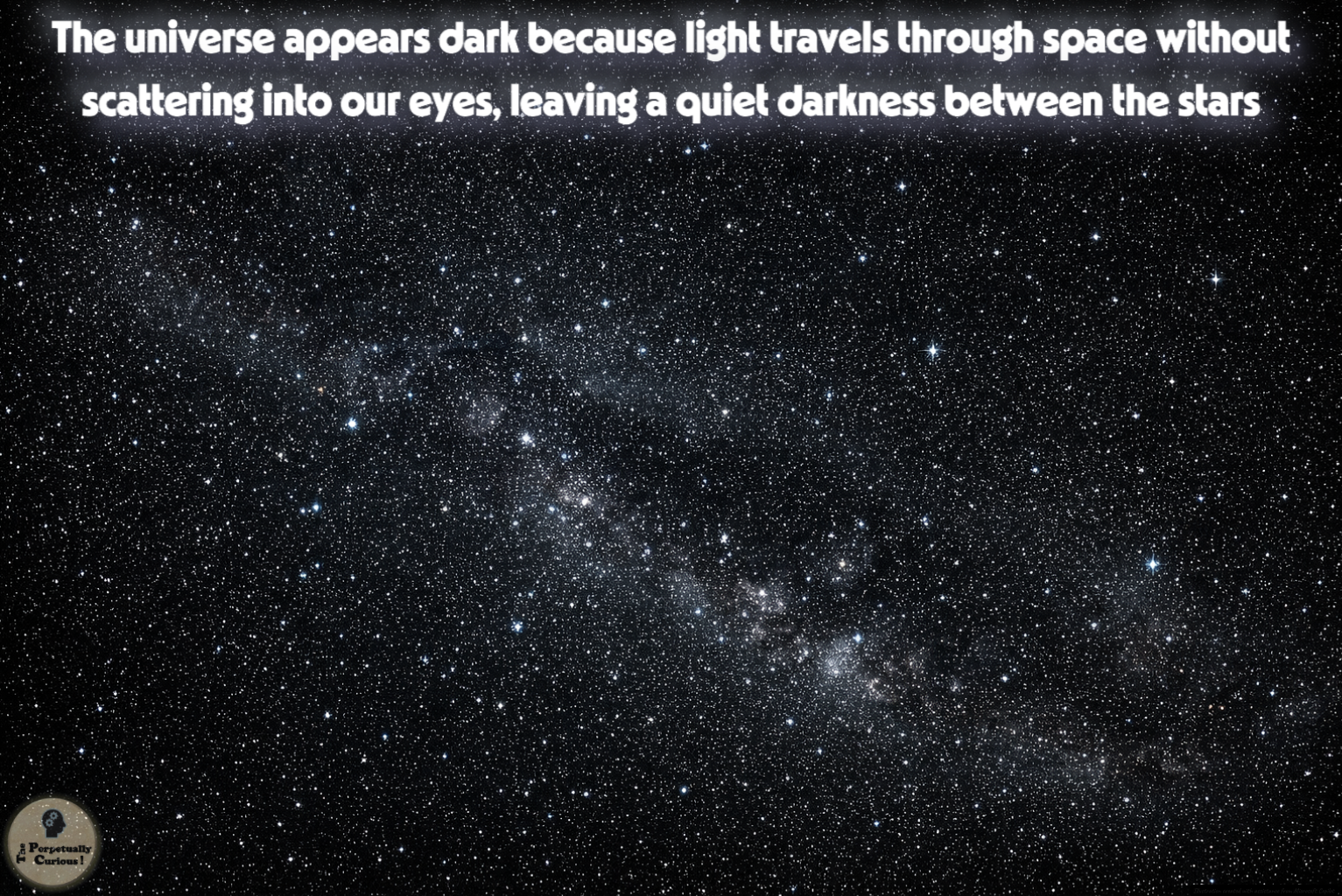
Space can look surprisingly dark, even in a universe filled with stars. That darkness is not simply the absence of light. It is often the result of how light travels, what it meets, and what it does not meet. On Earth, daylight becomes a bright blue sky because sunlight interacts with the atmosphere. In space, where matter is far more sparse, light can cross enormous distances without becoming visible along the way.
A familiar room offers the first clue. A flashlight beam looks visible when dust, smoke, or tiny particles scatter some of the light toward the eye. Without those particles, the beam itself would be harder to see, even though the light is still moving through the room. Space is similar in principle, but far more extreme. Between planets and stars, there is no thick atmosphere and very little material to scatter light sideways. A sunlit surface can shine brightly, while the space around it remains black.
That is why the question of why space looks dark is not really a question about whether light exists. It is a question about whether light is redirected, reflected, absorbed, or emitted in a way that reaches an observer. For readers who want the wider treatment of scattering, starlight, cosmic history, and hidden wavelengths, the complete article on the main site follows the idea in greater depth.
How light becomes visible
Light becomes visible to us when it enters the eye from a source, a reflective surface, or a glowing object. A star is visible because some of its light travels directly to us. The Moon is visible because sunlight reflects from its surface. A daytime sky is bright because countless air molecules scatter sunlight in many directions, allowing light to reach the eye even when one is not looking directly at the Sun.
In near-empty space, that scattered glow is mostly missing. Light still travels through the region, but it does not necessarily announce its path. This is why astronaut images can show brilliant sunlit surfaces below a black sky above. The surface has matter for sunlight to strike. The surrounding space does not contain enough atmosphere to spread that light across the whole view. Darkness, in this sense, is not a failure of light. It is a sign that most of the light is passing through without being redirected toward us.
Where the fuller cosmic question begins
The same idea also opens the door to a larger astronomical puzzle. If stars fill the universe, one might wonder why their combined light does not make the night sky bright everywhere. The answer involves more than sparse matter alone. Distance weakens the apparent brightness of individual stars. The universe also has a finite age, so not all light from all regions has had time to reach us. Expanding space can stretch distant light into wavelengths that human eyes cannot see.
The first layer is simple: light often crosses space without becoming visible because there is so little matter to scatter it. The main website article continues into the richer cosmic setting, including the night-sky paradox, the role of expansion, the hidden glow of other wavelengths, visual context, Did You Know notes, and a full FAQ.
🌌 Why Space Looks Dark in a Universe Filled With Light
https://www.theperpetuallycurious.org/articles/why-space-looks-dark
https://www.theperpetuallycurious.org/articles/why-space-looks-dark
🌌 Continue exploring this theme
More connected articles on stars, planets, cosmic structure, and the wider patterns shaping our universe are gathered on The Perpetually Curious! website.
Explore Cosmic Exploration Articles
Comments
Post a Comment