


🏭 Petroleum Refining: How Crude Oil Begins to Transform
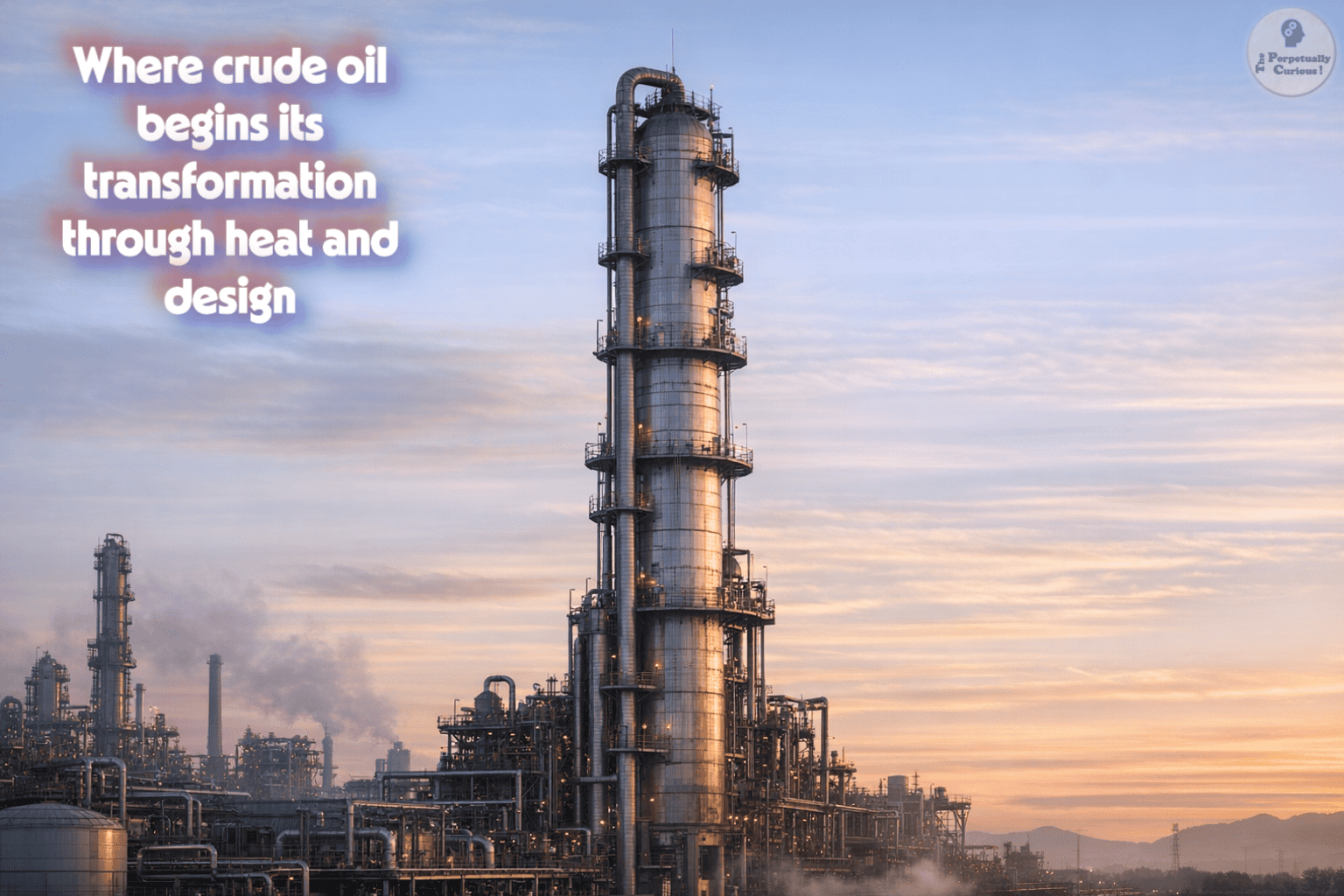
Petroleum refining begins with a deceptively simple challenge: crude oil is not one substance. It is a dense mixture of hydrocarbons, trace elements, salts, and fine materials that arrived from geological history with no concern for human categories. A refinery must first make that mixture readable. Before molecules are reshaped or fuels are blended, the crude has to be cleaned, heated, and separated into streams that behave in more predictable ways.
That is why the first major act is not transformation, but separation. Desalting removes much of the salt and fine solids that can corrode equipment, foul heat exchangers, or interfere with catalysts later in the refinery. After that early cleanup, heat prepares the crude for its first large sorting step. The goal is not to make gasoline instantly. It is to arrange a crowded mixture into useful families of boiling ranges.
This first step also explains why petroleum refining is a system rather than a single reaction. One crude oil may contain more light material, while another may carry a heavier share of dense molecules. A refinery has to respond to that starting material with the right sequence of heat, pressure, separation, and later upgrading.
The complete article on the main site continues into the larger refinery chain, including conversion units, hydrotreating, blending, energy recovery, visual diagrams, and the full FAQ.
Why boiling range matters
In atmospheric distillation, preheated crude enters a tall column where temperature and vapor movement do the first sorting work. Lighter components vaporize more readily and rise higher. Heavier components remain lower because they need more energy to vaporize. Inside the column, trays or packing help rising vapors and descending liquids meet repeatedly, allowing the mixture to settle into recognizable fractions.
This does not mean that every fraction is a perfectly pure chemical. Refinery streams are usually boiling-range families rather than single molecules. Light gases can leave near the top. Naphtha may move toward gasoline or petrochemical uses. Kerosene becomes important for aviation fuel. Diesel-range material condenses lower. Heavier gas oils and residue remain nearer the base. The vertical arrangement is useful because it gives the refinery a first map of what the crude can become.
Seen this way, the distillation tower is less like a container and more like an organized landscape. Heat does not simply boil the crude at once. It creates conditions where different portions of the mixture can find the level that best matches their volatility. This is why the tower becomes such a strong visual symbol of refining: it turns hidden molecular differences into a visible pattern of separated streams.
Why separation is not the finish
Atmospheric distillation cannot recover everything safely. Some heavy fractions would need such high temperatures at normal pressure that they could crack or degrade before they were cleanly separated. Vacuum distillation solves part of that problem by lowering pressure, which lowers boiling temperatures and allows heavier gas oils to be recovered with less thermal stress.
Even after that, separation alone is not enough. A barrel of crude does not naturally produce finished fuels in the proportions people use them. Some streams are too heavy. Others need sulfur, nitrogen, or unstable compounds removed. Some require molecular reshaping before they can become high-quality fuel components. That is why refineries include cracking, hydrocracking, reforming, hydrotreating, blending, and quality control as connected stages rather than isolated machines.
The first layer is simple: petroleum refining begins by using heat, pressure, and boiling behavior to make crude oil more orderly. The full article on The Perpetually Curious follows the wider pattern through molecular conversion, sulfur handling, hydrogen use, energy integration, supporting visuals, and the complete refinery-process explanation.
🏭 Petroleum Refining: The Process Behind Heat, Pressure, and Design
https://www.theperpetuallycurious.org/articles/petroleum-refining-process
https://www.theperpetuallycurious.org/articles/petroleum-refining-process
🛠️ Continue exploring this theme
More connected articles on built systems, engineered solutions, emerging technologies, and the design choices shaping how things work are gathered on The Perpetually Curious! website.
Explore Engineering & Technology Articles
Comments
Post a Comment