


✏️ Pencil Making: How Graphite and Cedar Become a Line
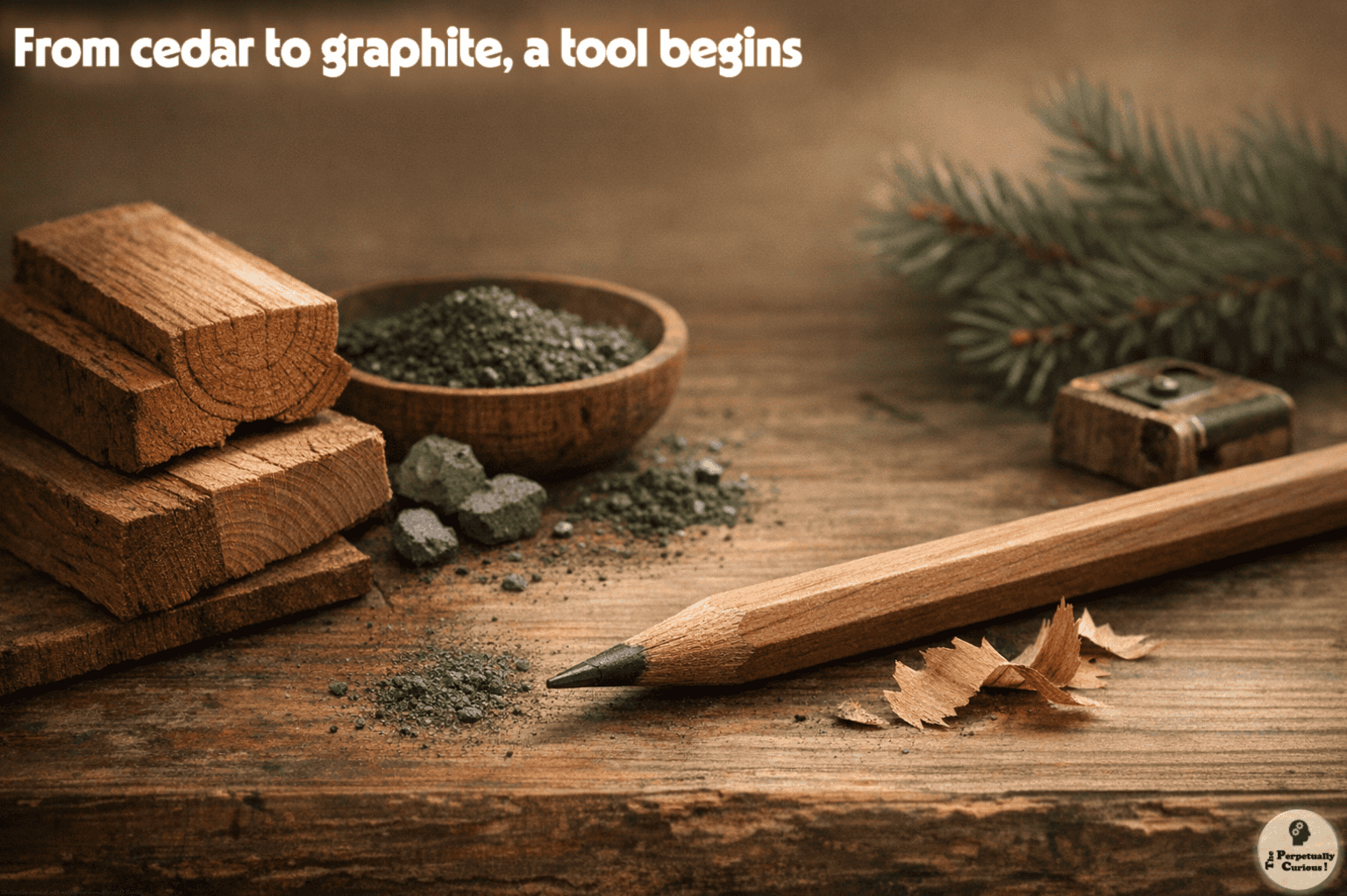
Pencil making begins with a small material puzzle. The finished object looks simple, but its usefulness depends on several materials behaving well together. The dark core must leave a visible line without crumbling too easily. The wooden body must sharpen cleanly without splitting. The surface must protect the pencil while still feeling comfortable in the hand. Behind the familiar tool is a careful match between graphite, clay, wood, and finishing choices.
That match is easy to overlook because a pencil feels so ordinary. It is picked up, sharpened, used, set down, and replaced without much thought. Yet the tool works because softness and strength are held in balance. The core must be weak enough to transfer onto paper, but strong enough to survive handling. The wood must be firm enough to protect the core, but gentle enough to shave away in controlled ribbons.
For the wider journey from raw ingredients to finished tool, the complete article on the main site follows the full sequence of forest wood, mined graphite, core firing, slat preparation, finishing, and the final eraser assembly.
Why graphite needs clay
Graphite alone is soft and slippery because its carbon atoms are arranged in layers that can slide over one another. That layered structure is why graphite can leave a mark on paper. Yet graphite by itself would be too fragile for a durable pencil core, so it is mixed with clay and water into a paste. More clay usually produces a harder, lighter line, while more graphite usually produces a softer, darker one.
This is why pencil grades are not just labels on the barrel. They reflect small differences in formulation and processing. The mixture is shaped into thin rods, dried, fired, and often treated with waxes or oils so the writing feel becomes smoother. In this quiet balance, pencil making becomes a form of controlled material design, where a simple line depends on the behavior of minerals under pressure, heat, and friction.
Why the wood matters
The wooden casing has to protect the fragile writing line while still allowing the pencil to be sharpened again and again. Softwoods such as cedar and similar species are valued because they can have straight, workable grain. When the grain is even, the wood can peel away in smoother shavings rather than breaking into rough splinters.
That behavior matters more than it may first appear. A pencil sharpener does not simply make a point; it exposes a fresh section of the core while removing just enough wood to support it. If the core sits off center, the point may become uneven. If the wood is too brittle, it may chip. If the core has fractured inside the pencil, it may break repeatedly during sharpening. The ordinary act of sharpening therefore reveals the hidden quality of the earlier manufacturing steps.
Once the core and wood are brought together, the pencil becomes a small engineered composite. A grooved wooden slat holds the core in place, another slat closes over it, and adhesive binds the parts into a single piece. Later shaping gives the pencil its round, triangular, or familiar hexagonal form. The hexagonal shape is especially common because it is comfortable to hold and less likely to roll across a flat surface.
The finished pencil may seem humble, but it carries a layered history in its body. Its mark comes from graphite. Its firmness comes from clay. Its grip and sharpening behavior come from wood. Its color and identity come from finishing. The central idea is simple: a pencil works because several modest materials are brought into quiet cooperation. The full version on the main site carries that story into the richer process details, supporting visuals, Did You Know notes, FAQ, and related article connections reserved for the complete article on The Perpetually Curious.
🧪 The Quiet Alchemy of Pencil Making: How an Everyday Tool Comes into Being
https://www.theperpetuallycurious.org/articles/pencil-making
https://www.theperpetuallycurious.org/articles/pencil-making
🛠️ Continue exploring this theme
More connected articles on built systems, engineered solutions, emerging technologies, and the design choices shaping how things work are gathered on The Perpetually Curious! website.
Explore Engineering & Technology Articles
Comments
Post a Comment