

💧 Seasonal Ponds and Root Depth in South India
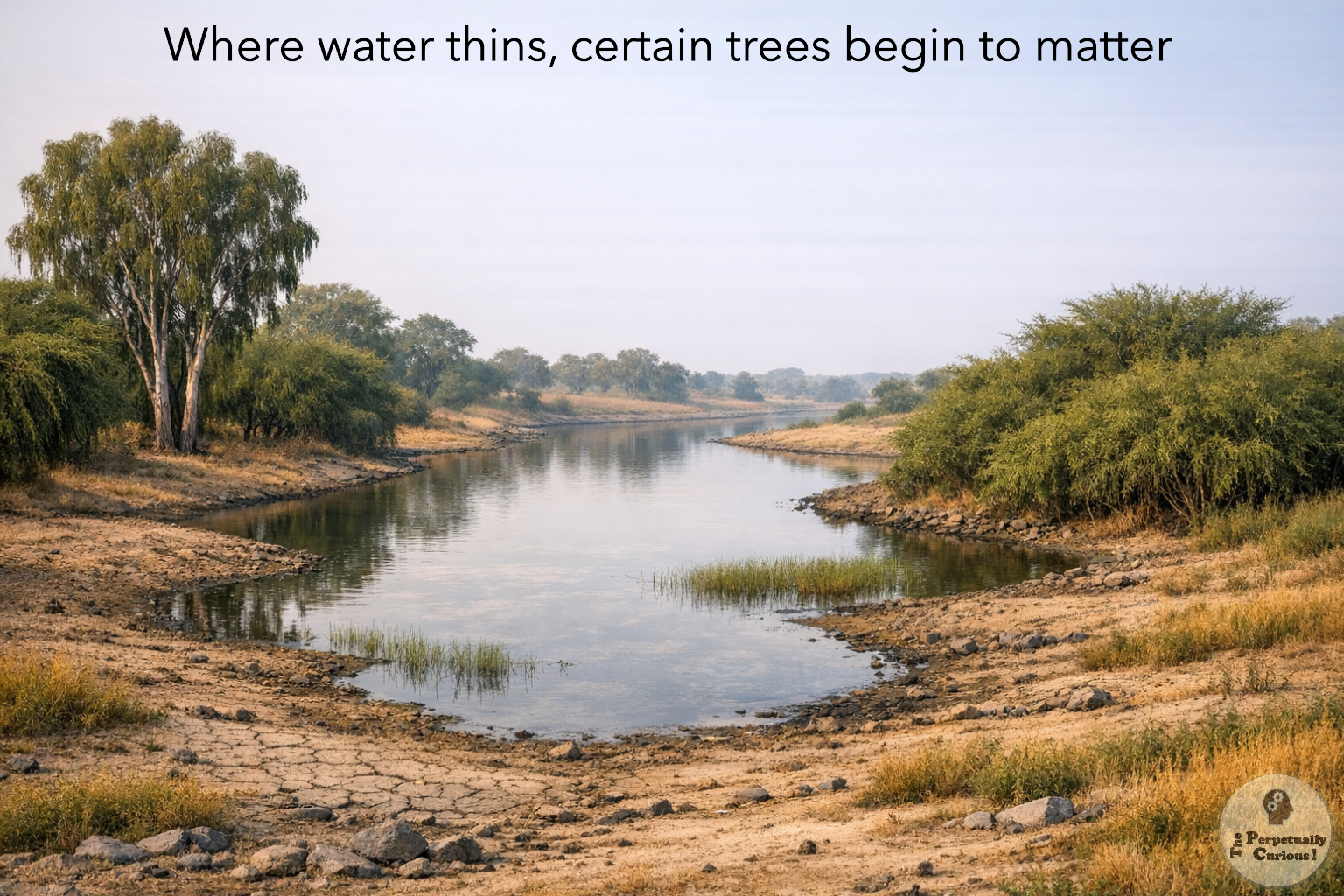
Seasonal ponds often look still from a distance, yet their edges can hold some of the most active negotiations in a dry landscape. In parts of South India, stored rainwater, shallow aquifers, dry soil, and plant roots meet in a narrow zone where each season leaves its mark. A pond may shrink, grasses may return, shrubs may thicken, and certain trees may continue drawing moisture from depths that are invisible at the surface.
This compact companion looks at one central idea from the larger article: how root depth and water access shape the way vegetation interacts with seasonal ponds. Some plants depend mainly on upper soil moisture. Others develop deeper access to stored water, including water held near shallow aquifers. The result is not a simple story of trees taking water away. It is a site-specific relationship shaped by rainfall, soil depth, geology, planting density, and the history of the surrounding land.
For readers who want the species-by-species discussion, visual explanation, and wider ecological context, the complete article on the main site follows this water story in greater depth.
How roots change the pond-margin story
Around a seasonal pond, the visible landscape tells only part of the story. Above ground, a tree or shrub may appear as a patch of shade, a thicket, or a line of green along a drying margin. Below ground, its roots may occupy very different layers of soil. Shallow root zones use moisture near the surface after rain. Deeper root systems can reach lower moisture reserves when the upper soil has dried. This difference helps explain why some species remain green through dry months while nearby grasses and herbs fade back.
In South Indian landscapes, this question becomes especially important around tanks, canals, pond margins, and semi-arid fields. Species such as Prosopis juliflora, eucalyptus, introduced acacias, Lantana, and Ipomoea do not all use water in the same way. Some are discussed because of deep root access or high stand-level water use. Others matter because dense growth can alter light, movement, access, or surface flow near wet edges. The pattern depends on place, not on a single universal rule.
That caution matters. A plant may provide fuelwood, shade, cover, or economic value in one setting while becoming a pressure on water, grazing land, or native vegetation in another. Ecology often resists simple labels. The same species can be understood as resource, disturbance, survivor, or warning sign depending on the landscape being observed.
Where the full story continues
This Blogger version stays with the first layer of the idea: seasonal ponds are shaped not only by rainfall and evaporation, but also by the way roots, shrubs, soils, and shallow water tables interact. The main website article keeps the fuller structure, including the South Indian species context, the distinction between native and introduced plants, the hydrological nuance around eucalyptus and Prosopis, and the quieter human dimension of livelihoods, land use, and careful scientific language.
For readers who want the complete version, including the richer visual context, Did You Know notes, FAQ, and related botanical links, continue with the full article below:
Trees That Drink the Sky: How Certain Species Shape Water and Land in South India
Read the full version on the main site
Read the full version on the main site
🌿 Continue exploring this theme
More connected articles on plant life, botanical adaptations, plant ecologies, and the living patterns that shape the green world are gathered on The Perpetually Curious! website.
Explore Botanical Wonders Articles
Comments
Post a Comment