
🪐 Gravity on Other Planets: Why Weight Changes from World to World
Imagine carrying the same 70 kilogram mass from Earth to Mars and then to the Moon. Nothing about the object itself has disappeared or been added, yet the force needed to support it would change at every stop. That contrast offers one of the clearest ways to understand gravity on other planets.
On Earth, a 70 kilogram mass corresponds to about 687 newtons of weight. On Mars, where gravitational acceleration is only about 38 percent of Earth’s, the same mass corresponds to about 260 newtons. The Moon produces a still smaller supported weight. The mass remains constant. The gravitational environment does not.
⚖️ The number that changes is weight, not mass
Everyday language often treats mass and weight as if they were interchangeable. In physics, mass is measured in kilograms and does not change merely because an object moves to another world. Weight is the force gravity exerts on that mass, so it depends on the local gravitational acceleration.
On solid ground, the familiar sensation of weight comes largely from the supporting surface pushing upward while gravity pulls downward. Change the local gravity and that supporting force changes too. This is why movement can feel lighter or heavier even though the mass is unchanged.
This is why the same equipment would be easier or harder to support on different worlds even though it contains the same amount of matter. Lower gravity reduces supported weight. Stronger gravity increases it. The distinction is simple, but it prevents a common misconception: traveling to a low-gravity world does not make an object lose mass.
🪐 Why bigger does not always mean stronger
Planetary gravity is shaped mainly by two properties: how much mass a world contains and how far its reference level lies from the center. More mass generally strengthens gravitational pull, while a larger radius places the reference level farther from the planet’s mass.
That is why size alone can mislead. Mercury is much smaller than Mars, yet their surface gravity is remarkably similar because Mercury is dense and compact. Saturn is enormous, but its large radius and low average density leave its conventional reference-level gravity only modestly above Earth’s. Jupiter combines enormous mass with much stronger gravity, although its quoted value is measured at a conventional atmospheric reference level because there is no solid surface on which a person could stand.
The wider planetary comparison on our main site places these contrasts in a full Solar System context, including the values for the major planets, the Moon, Pluto, and the reference-level caveats needed for the giant planets.
🌌 A scale reading is only one expression of gravity
The same physics that changes supported weight also influences how worlds behave. Weaker gravity can make it easier for loose material to move and for some atmospheric particles to escape. Stronger gravity can help a world retain material more tightly, although temperature, composition, radiation, geology, and other factors also matter.
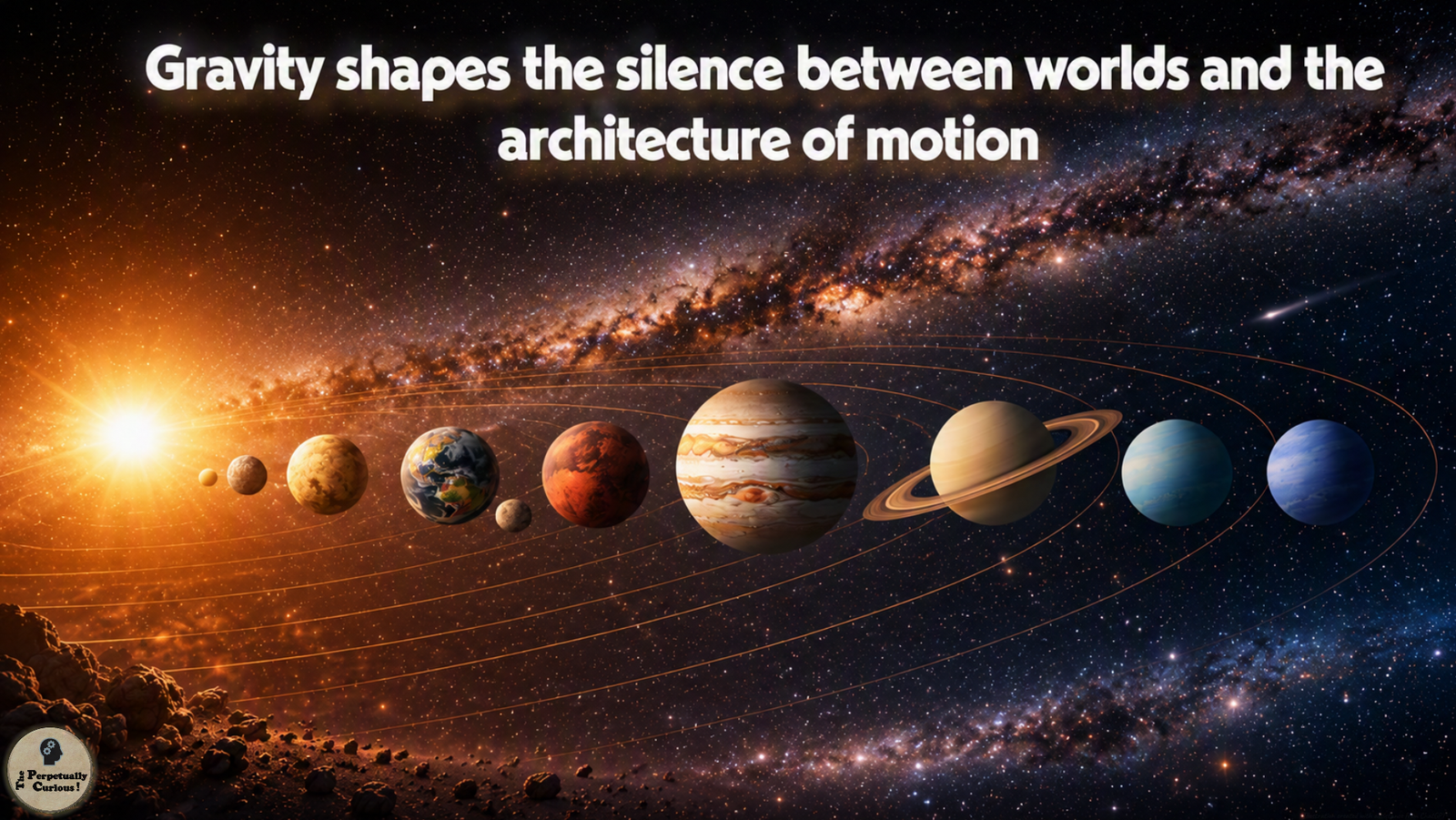
Gravity also acts far beyond a planetary surface. The same gravitational relationships guide spacecraft through gravity assists, where a carefully planned encounter with a moving planet can change a spacecraft’s path and speed relative to the Sun. That application reveals something important: gravity is not simply a downward pull experienced while standing on the ground. It is part of the architecture of motion throughout the Solar System.
A comparison of planetary gravity therefore tells two stories at once. It explains why the same mass can correspond to different weights from one world to another, and it offers a compact clue to how mass, size, and motion shape planetary environments. The supported force changes because the world changes, while the mass quietly remains the same.
Comments
Post a Comment