


🥛 Types of Animal Milk: Why Biology and Landscape Matter
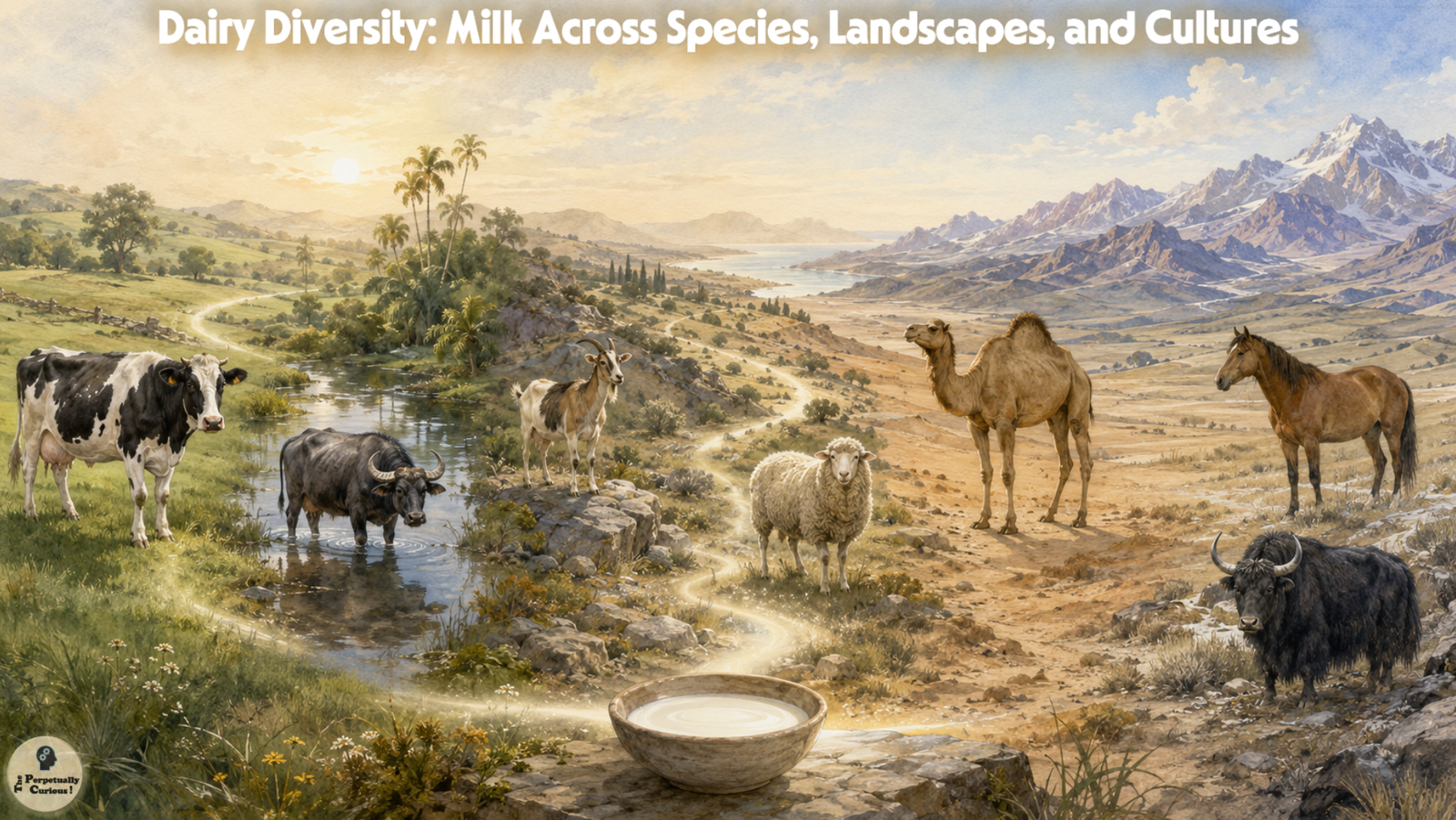
Milk can look almost identical from one glass to another, yet the biology behind it is not identical at all. Every mammal produces milk for the needs of its own young, so the balance of water, fat, protein, lactose, and minerals begins with species physiology rather than with a human recipe. When people began dairying, they inherited those biological differences and learned how to work with them.
One liquid, different starting points
Cow milk became the foundation of large modern dairy systems because cattle are widely raised and their milk adapts well to many forms of processing. Buffalo milk begins from a richer composition, with more fat, casein, calcium, and total solids than cow milk in typical comparisons. That difference helps it form strong curds and dense textures, which is one reason buffalo milk works so well in foods such as mozzarella, paneer, yogurt, and concentrated sweets.
The important point is not that one milk is simply richer and another lighter. Composition acts as a system. Casein influences curd formation, fat affects richness and aroma, lactose can feed fermentation, minerals help shape protein behavior, and water determines how concentrated the whole mixture is. Change the balance and the same processing step can produce a noticeably different result.
Mare and yak milk show how wide that biological range can become. Mare milk is relatively low in fat and protein but higher in lactose than most ruminant milks. Yak milk moves in the opposite direction, with comparatively high fat, protein, and total solids. One lends itself to fermented drinks such as koumiss or airag, while the other supports butter, cheese, fermented foods, and milk tea in high-altitude communities.
Landscape changes what becomes useful
These differences matter because dairy animals do not live in interchangeable environments. Camels remain productive in arid and semi-arid regions where heat, limited water, and sparse forage place strong constraints on other livestock. Yaks tolerate cold and low oxygen at high elevations. Goats can browse shrubs and use broken terrain that may be difficult for cattle. Buffaloes are particularly well suited to warm, wet settings.
That does not mean geography directly designs the chemistry in a simple one-to-one way. Breed, feed, age, stage of lactation, season, water, and management can all shift composition within the same species. A label such as cow milk or goat milk describes a broad biological family, not a fixed formula.
The larger main-site treatment follows this pattern across all seven animals, keeping the wider composition, processing, environmental, and cultural context together rather than reducing dairy diversity to a single nutrient or ranking.
Culture completes the transformation
Human technique adds another layer. Once milk leaves the animal, heat, acid, rennet, salt, drainage, churning, microorganisms, and time can move it in very different directions. The starting chemistry sets possibilities, but people learn which possibilities fit local foods, tools, climates, and inherited practices.
That is why milk diversity is both biological and cultural. Buffalo milk can become paneer or sweets. Mare milk can become a lightly alcoholic fermented drink. Yak milk can enrich butter or tea. Sheep milk can support concentrated cheese traditions. These foods are not products that evolution designed for human kitchens. They are the result of people learning how a species-specific biological material behaves and then carrying that knowledge forward.
A glass of milk therefore contains more than a list of nutrients. It begins with mammalian biology, passes through landscape and husbandry, and enters culture through technique. The differences between animal milks are not a contest for a universal best. They are a record of different starting materials meeting different places, needs, and traditions.
Comments
Post a Comment