
🌌 Evidence for Dark Matter: How Scientists Find the Invisible
The universe is filled with things we can see: stars glowing across galaxies, clouds of gas between them, and light traveling across billions of years. Yet some of the strongest evidence in modern astronomy points toward something we cannot directly observe.
Dark matter is the name given to this unseen component of the cosmos. It does not appear to emit or absorb light in the way ordinary matter does, but its presence is revealed through the gravitational effects it creates.
When gravity reveals what light cannot
One of the most powerful ideas in astronomy is that objects can be detected through their influence, even when they remain invisible. Scientists do this by observing how visible matter moves and how light behaves as it travels through space.
Galaxies rotate in ways that cannot be explained by the mass we can see alone. Large galaxy clusters bend light from more distant objects, creating patterns that reveal where additional gravitational mass must exist.
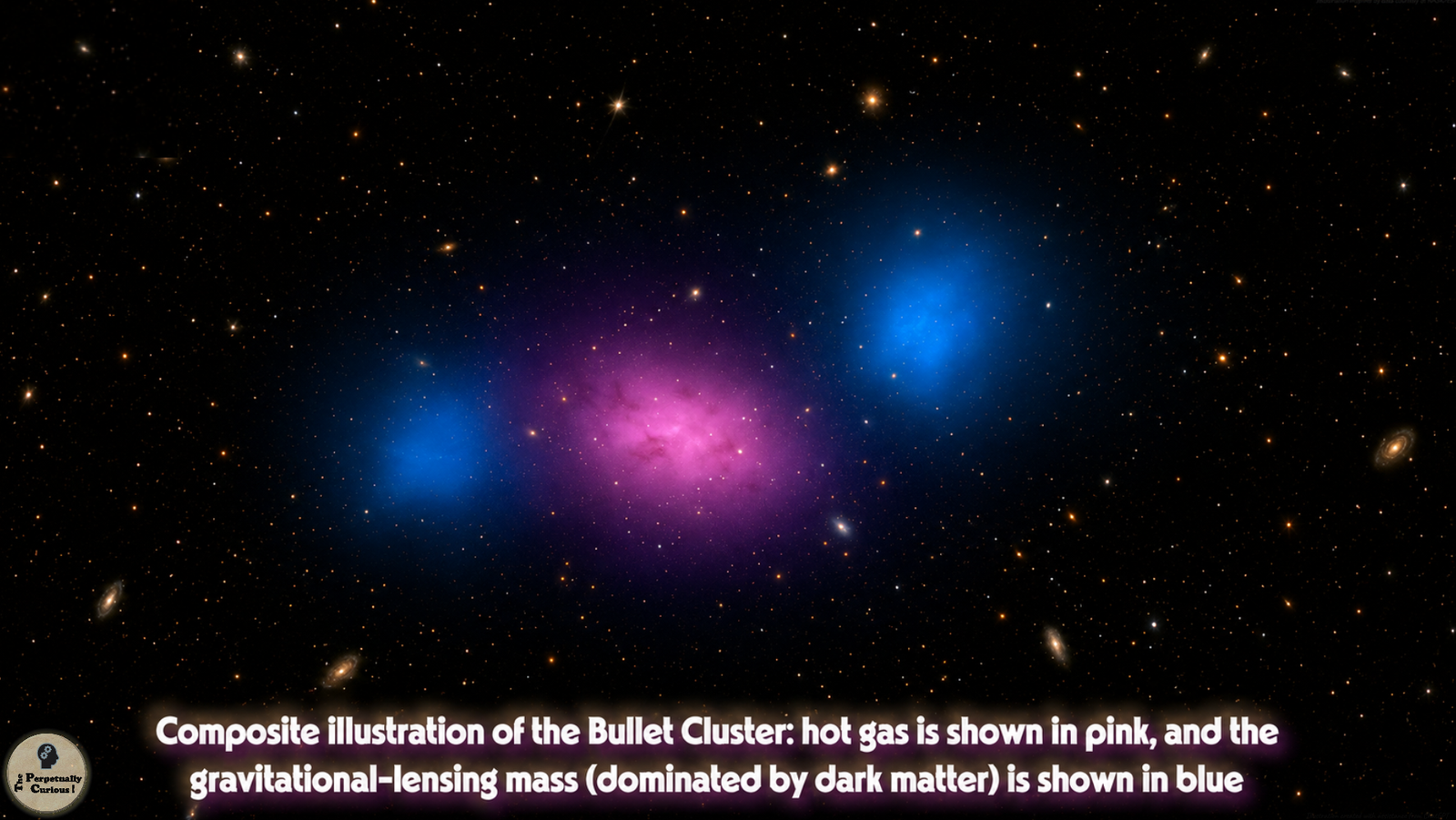
The Bullet Cluster provides one of the clearest examples of this reasoning. In this massive collision between galaxy clusters, observations show a separation between the hot X-ray-emitting gas and the distribution of gravitational mass inferred through lensing. The result suggests that most of the mass in the system is not located where the ordinary matter appears.
The science of following invisible fingerprints
This approach is similar to identifying something by the traces it leaves behind. Scientists do not need to see dark matter directly to study its effects. They can examine the motion of galaxies, the structure of galaxy clusters, and the way light is altered as it travels through the universe.
These observations form a connected pattern of evidence. Each clue comes from a different cosmic scale, but together they point toward additional mass shaping the architecture of the universe.
The larger story includes many more pieces, from early-universe observations to carefully designed experiments searching for possible dark matter particles. The broader treatment on our main site follows how these clues developed into one of modern science's greatest mysteries: the evidence for dark matter.
Dark matter remains unseen, but its influence is written across the cosmos. Sometimes the universe reveals its hidden structures not through direct sight, but through the patterns left behind.
Comments
Post a Comment