
📡 Cosmic Microwave Background: How a Faint Hiss Became Cosmic Evidence
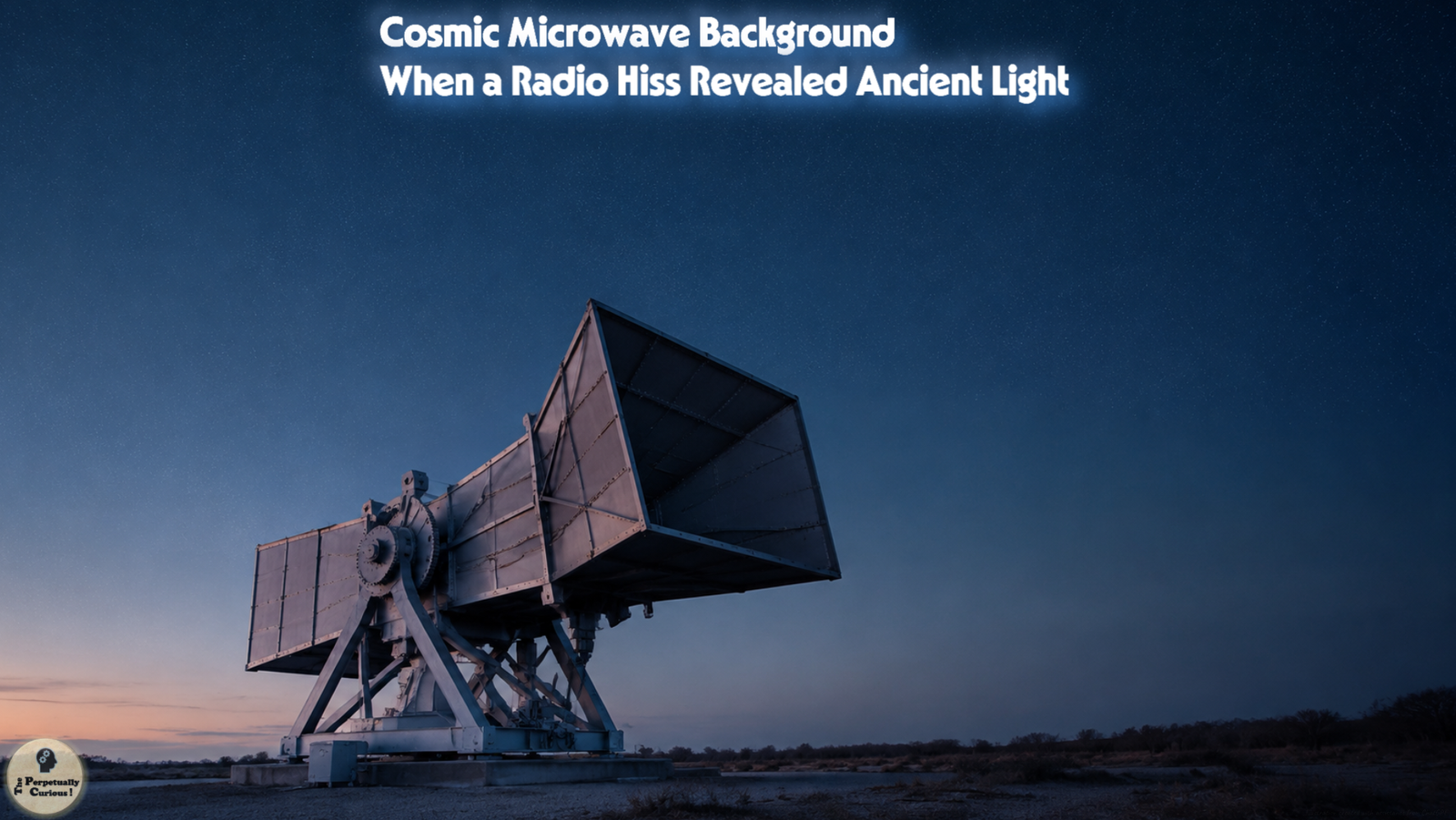
In 1964, a faint hiss refused to disappear from the Holmdel Horn Antenna at Bell Labs. Radio astronomers Arno Penzias and Robert Wilson checked equipment, considered interference, and cleaned contamination from the antenna. The noise remained. What seemed like an instrumental nuisance was arriving from every direction, and its persistence eventually connected their work to a prediction from early-universe cosmology.
The signal was the cosmic microwave background, or CMB. It is not light from the first instant of the Big Bang. It comes from a later threshold, about 380,000 years after the Big Bang, when the universe had cooled enough for light to begin traveling freely across space.
From an opaque universe to a traveling signal
Before that transition, ordinary matter existed largely as an ionized plasma of nuclei and free electrons. Photons repeatedly scattered from charged particles, so radiation could not move far in a straight line. The early universe contained light everywhere, but it was not yet transparent.
Expansion changed the situation. By roughly 380,000 years, the temperature had fallen to about 4,940°F (3,000 K). Electrons could combine with protons to form neutral hydrogen, greatly reducing the number of free electrons available to scatter photons. Light decoupled from matter and began a journey that has continued for almost 13.8 billion years.
Cosmic expansion stretched those wavelengths along the way. Radiation that began as the thermal glow of a much hotter universe is now observed as microwaves at about minus 454.76°F (2.725 K). The background is nearly uniform, but not perfectly so. Tiny variations, only about one part in 100,000 after the much larger dipole from our motion is removed, preserve information about conditions in the young universe.
How a hiss became evidence
Once the background could be mapped rather than merely detected, the faint signal became a precision tool. Small temperature differences across the sky reflect a statistical mixture of early density, velocity, and gravitational conditions. Over billions of years, gravity amplified those initial differences into the large-scale structure from which galaxies eventually emerged.
The pattern becomes even more revealing when scientists organize the temperature variations by angular scale. The resulting CMB power spectrum contains a sequence of acoustic peaks. These trace pressure oscillations in the primordial photon-baryon fluid, where gravity drew matter inward while radiation pressure resisted compression.
The peak positions and relative heights constrain several properties of the cosmos. They help measure spatial geometry and the amounts of ordinary matter and dark matter. That connection also provides an early-universe counterpart to the later gravitational evidence for dark matter seen in galaxies and clusters.
The larger main-site treatment follows this signal much farther, including polarization, Silk damping, foreground removal, large-scale anomalies, the limits of cosmic variance, and the experiments still searching for fainter traces in the microwave sky.
A quiet signal with a long reach
The CMB is easy to overlook because human eyes cannot see microwaves and because each photon carries very little energy. Yet the background fills the space around us. Its importance comes not from brightness but from what its statistical pattern preserves.
That is the enduring surprise behind the Bell Labs story. A noise researchers wanted to remove became evidence they could not ignore. The same faint background that once seemed like interference now provides one of cosmology's clearest records of a universe before stars and galaxies had formed.
The signal is ancient, but the questions carried within it remain open. Every more precise map asks the same basic question in a new way: what can the oldest freely traveling light tell us about the universe that produced it?
Comments
Post a Comment