
☕ Why Coffee Affects People Differently: The Caffeine Clock
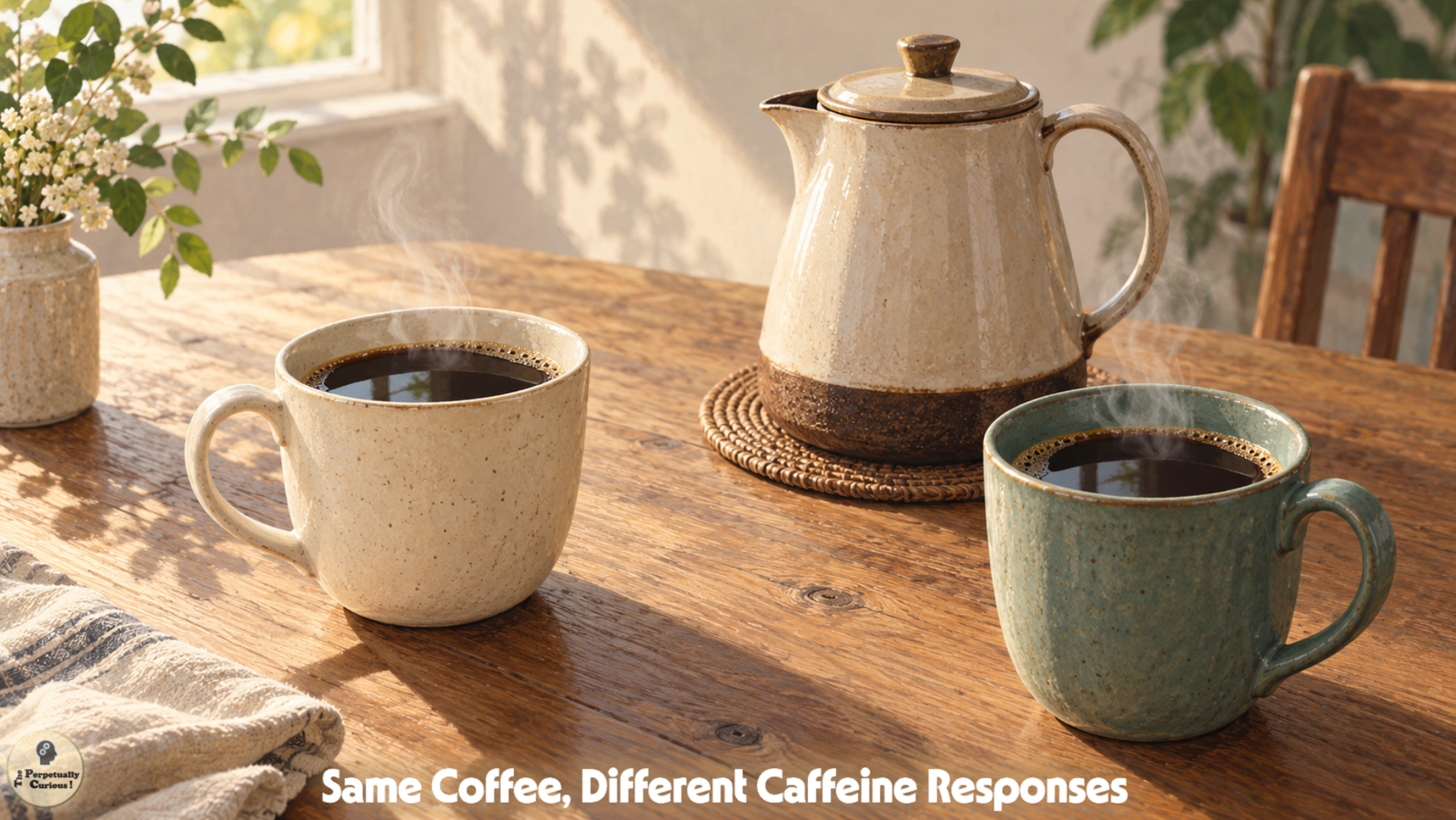
A coffee cup can be empty long before its caffeine story is finished. By late morning, the drink itself is gone, yet part of the dose may still be moving through the bloodstream. For another person, the same amount may be cleared more quickly. That difference is one reason a familiar ritual can carry a very different timetable from one body to another.
⏳ One cup does not carry one clock
One of the main timekeepers sits in the liver. An enzyme called CYP1A2 carries out most of caffeine's initial metabolism, helping transform the molecule into related compounds that can be processed further and eventually eliminated. The enzyme does not work at exactly the same pace in every person. Genetic variation contributes to those differences, while physiology and chemical exposures can change enzyme activity as well.
This is where caffeine half-life becomes useful. Half-life is the time required for the concentration of caffeine to fall by about half during elimination. It does not describe a sudden cutoff. If a simplified example begins with a five-hour half-life, about half of the caffeine remains after five hours and about a quarter after ten, assuming clearance stays similar and no more caffeine is consumed.
That gradual decline changes the meaning of a second cup. Coffee added later in the day may arrive while some caffeine from an earlier serving is still present. The effect can therefore overlap across time rather than beginning from zero with every mug. The cup may be new, but the bloodstream may still contain part of the earlier dose.
🕰️ Half-life is a slope, not a switch
Half-life is also a population tool rather than a personal stopwatch. It describes a rate of decline under particular conditions. It cannot tell someone the exact minute when caffeine will stop being noticeable, because the felt response depends on more than concentration alone. Even two people with similar clearance can experience the remaining caffeine differently.
The clock is not purely metabolic. Caffeine exposure also meets the body's biological clocks, which help organize daily patterns of sleepiness and alertness. This does not mean that one clock predicts the other. It means that the same concentration of caffeine can arrive against a changing physiological background as morning becomes afternoon and evening.
It is tempting to turn these differences into two neat categories: fast metabolizers and slow metabolizers. That shorthand can be useful, but the biology is less tidy. Genetic variants can influence CYP1A2 activity, yet they do not assign every person a permanent clearance time. Dose, recent caffeine use, physiological state, and other exposures can all change the context in which the enzyme is working.
☕ The useful lesson is variation, not a label
That distinction matters because clearing caffeine and feeling caffeine are not identical questions. A person may feel less stimulated even while caffeine remains in the body, and another may notice an effect strongly at a similar exposure. The metabolism clock tells us how the molecule is being cleared. It does not, by itself, tell us the complete experience.
This is also why an everyday reaction to coffee should not be treated as a laboratory measurement of enzyme activity. Researchers can study caffeine metabolism under controlled conditions, but the ordinary cup arrives with too many changing variables to function as a personal metabolic test. The familiar experience is useful as an illustration of biological variation, not as a diagnostic shortcut.
The broader main-site treatment follows why coffee affects people differently across dose, nervous-system response, changing physiology, medications, and the limits of what a coffee reaction can reveal about metabolism. The narrow lesson here is simpler: a cup does not carry one universal countdown.
By the time the mug is washed and returned to the cupboard, the chemistry it started may still be unfolding. The familiar ritual ends quickly. Its molecular timetable does not always do the same.
Comments
Post a Comment