

🌳🍂 Harmony of Hues: Painting the Landscape with Crimson and Gold
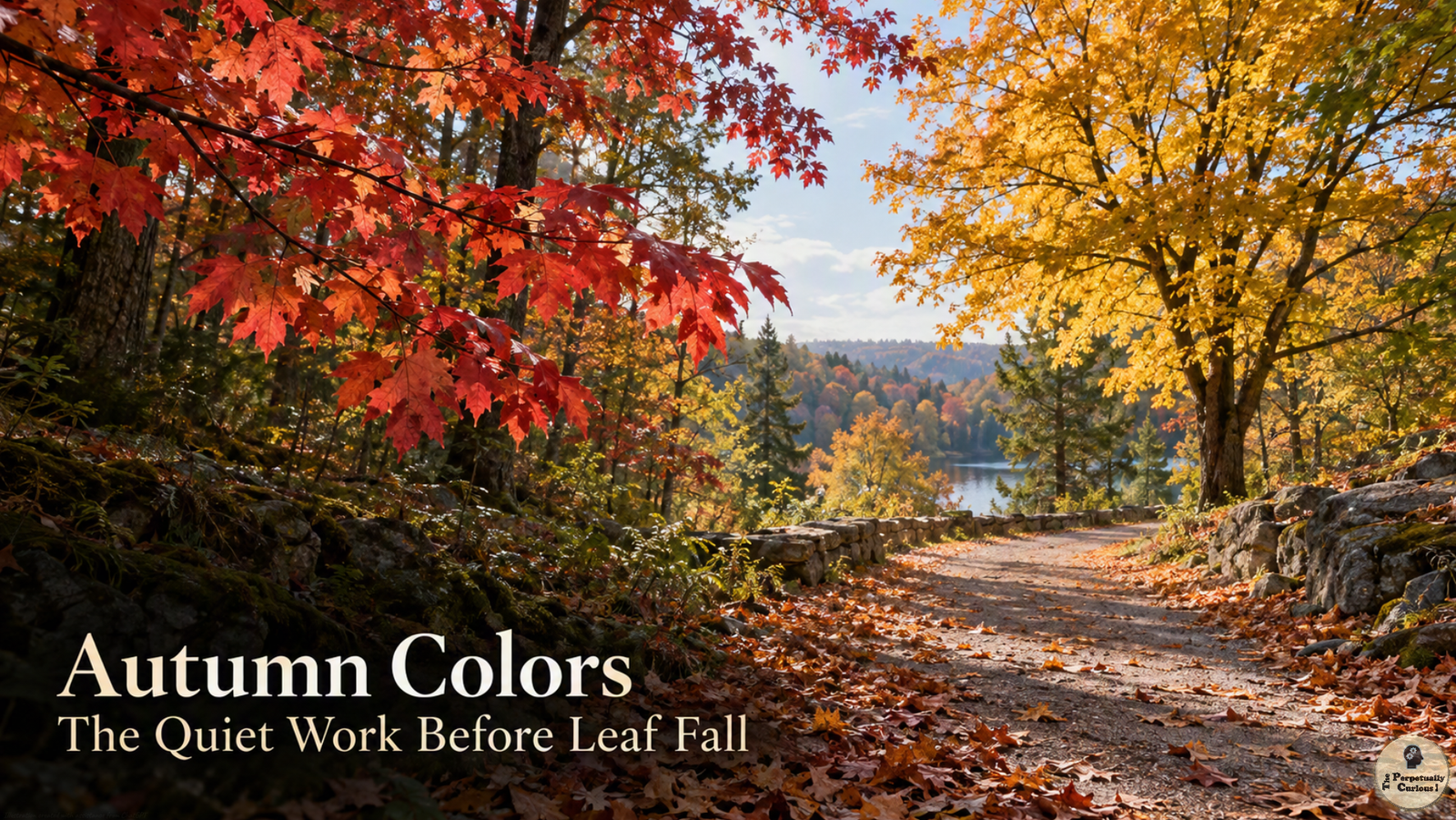
An autumn leaf can turn yellow because something disappears, red, in many species, because something new is made, and brown as living tissue reaches its end. Those colors may share a branch, but they do not arise by one chemical route. The familiar change from green to gold or crimson begins when a leaf enters senescence, the regulated transition that prepares it to be shed.
🍃 When green stops dominating
During the growing season, chlorophyll is abundant in most leaves. It absorbs light used in photosynthesis, and its strong green color masks much of the yellow and orange already present. As days shorten and conditions shift, many temperate deciduous trees begin dismantling chlorophyll and parts of the photosynthetic machinery around it. The leaf is not simply fading. It is being reorganized.
Day length is one part of how plants keep seasonal time, alongside temperature, water availability, and species-specific responses. During senescence, some nutrients that would otherwise leave with the falling leaf can be transferred back into the tree. Nitrogen is especially important because chlorophyll and many photosynthetic proteins contain it. As the green pigment declines, the changing chemistry also alters what our eyes can see.
🎨 Yellow is revealed, red is made
Yellow and orange often appear through subtraction. Carotenoids were already helping the leaf manage light during summer, but chlorophyll usually dominated the visible color. When chlorophyll breaks down, xanthophylls and carotenes become easier to see, allowing yellow and orange tones to emerge without requiring the tree to create a completely new autumn palette.
Red follows a different route. In many species that turn red, anthocyanins are synthesized during autumn senescence rather than simply uncovered. Their production can be favored by light, cool conditions, and available sugars, but not every tree has the same capacity to make them. That is why one branch may deepen toward crimson while another nearby tree settles into gold. The exact shade can also reflect the cellular environment surrounding the pigment and the presence of other colors in the leaf.
Brown is different again. It is not always a final hidden pigment waiting beneath chlorophyll. As leaf tissues age and die, compounds can oxidize and cellular structures break down. Tannins can contribute to russet and brown tones, but no single molecule explains every brown autumn leaf.
🍂 Color as part of a departure
These different color routes unfold while the leaf is moving toward separation from the tree. A developing separation zone at the base of the leaf stalk eventually allows it to detach, while nutrient recovery and pigment change proceed around the same seasonal transition. Weather can brighten, mute, delay, or shorten the visible display, but it does not erase the basic distinction between pigments that were already present and pigments that may be newly produced.
That larger seasonal picture, including why weather changes the display, why neighboring species differ, and what happens after a leaf reaches the forest floor, is developed in the wider main-site treatment of autumn color. The broader view also follows nutrient recovery, leaf fall, and the organisms that continue the cycle below the canopy.
Seen this way, autumn color is not one pigment replacing another. It is a sequence of disappearance, exposure, new synthesis, and tissue aging, all folded into the larger act of letting a leaf go.
Comments
Post a Comment