
🌊 Microplastics in the Ocean: How Tiny Fragments Travel
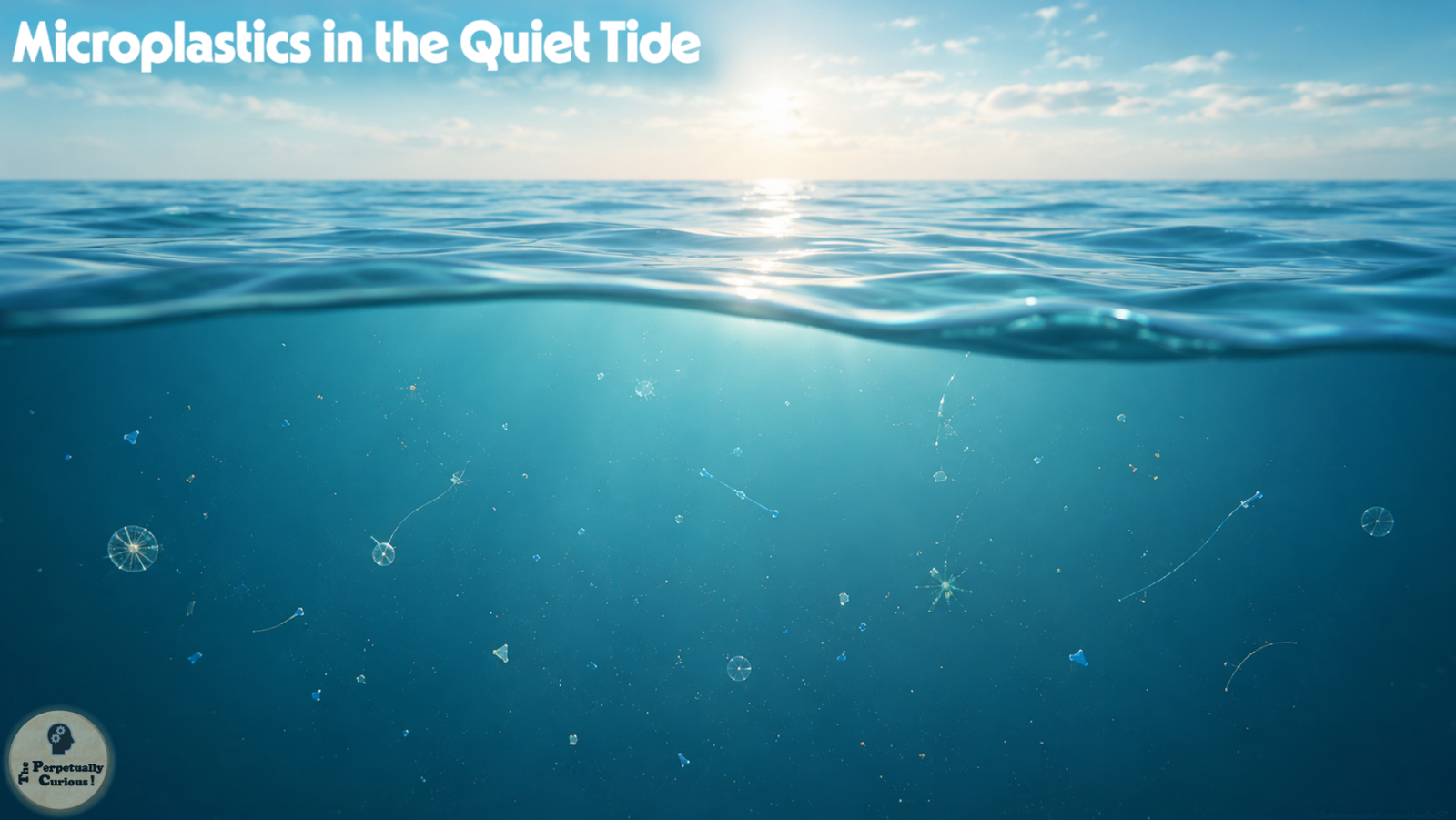
Microplastics in the ocean are not only small pieces of plastic. They are mobile fragments, shaped by weathering, water movement, and the living systems they pass through. Once plastic reaches rivers, beaches, storm drains, or coastal waters, sunlight, abrasion, waves, and time can break larger items into particles smaller than about 5 millimeters. Other particles begin even smaller, including synthetic fibers shed from fabrics or tiny material released from human activity on land and at sea.
The important shift is not only size. It is movement. A bottle cap, rope fiber, packaging fragment, or worn synthetic thread may begin as a visible object, but the ocean rarely leaves material in one place. Currents, tides, turbulence, and wind-driven surface motion can carry particles across water columns and coastlines. Some fragments float near the surface. Others mix downward, become coated with organic matter, or settle into sediment. In each case, a human-made material begins to join the ordinary motion of the ocean.
A small material with a long route
The route from land to sea often begins quietly. Rain can wash fragments from roads into drains. Rivers can carry particles from inland waste streams toward estuaries. Coastal litter can weather in sun and surf until it becomes small enough to move like suspended grit. Fishing gear, shipping materials, and aquaculture equipment can fray or degrade directly in marine spaces.
Once these particles enter water, their shape matters. A dense pellet, a thin film, and a flexible fiber do not behave in exactly the same way. Size, density, surface texture, and biological coating all influence whether a particle floats, sinks, drifts, or becomes available to organisms. That is why microplastics are difficult to describe with one simple pathway. They are not one substance moving in one direction. They are a family of particles moving through changing ocean conditions.
The larger version on our main site follows the wider chain through marine organisms, habitat effects, food-web movement, human exposure questions, and the deeper research context that surrounds this topic.
Why movement becomes exposure
Movement matters because it creates encounters. Filter-feeding animals can draw particles from water while feeding. Small crustaceans and planktonic organisms may meet fragments that overlap with the size of natural food. Sediment-dwelling animals can encounter particles mixed into sand, silt, or organic matter. Fish and larger animals may meet microplastics directly in the water column or indirectly through prey.
This does not mean every encounter produces the same result. Effects vary by species, particle type, concentration, and exposure time. A smooth fragment is not the same as a sharp fiber. A brief encounter is not the same as repeated retention. The strongest way to understand the issue is therefore not as a single dramatic effect, but as a network of possible contacts that depend on place, biology, and particle behavior.
Within the broader Environment & Sustainability collection, microplastics belong to a larger pattern of pollution, waste movement, and material systems that do not end at the point of disposal.
When the ocean sends fragments back
The loop becomes especially clear when ocean particles return toward human communities. Some may move through seafood pathways, especially where soft tissues are eaten whole. Others have been detected in sea salt or water samples. Tiny particles may also become part of sea spray or airborne movement when waves break and bubbles burst at the surface.
These pathways do not prove one simple health outcome. Research is still working to clarify which particles matter most, at what levels, and under which biological conditions. The more immediate lesson is about connection. Plastic released in one place can fragment, travel, meet living systems, and return in altered form. The ocean does not merely receive material. It carries it, reshapes its route, and reminds us that human systems and marine systems are less separate than they seem.
Comments
Post a Comment